Your favourites are only temporarily saved. To find them back, create your account on GFM Painting!
Already have account ?
No gift cards in your cart.
November 13, 2026


A family portrait is more than a decorative painting. It is a personal work of art that brings together the people, relationships and memories that matter most. Whether it captures a family at a particular moment in time, celebrates a special occasion or brings together relatives across generations, a carefully commissioned portrait can become a lasting part of a family's history.
Commissioning a family portrait is different from purchasing an existing painting. The artwork is created around the people being portrayed, using photographs, personal preferences and discussions about the desired composition, artistic style and finish. Every decision, from the number of family members and their positioning to the size, medium and background, contributes to the final result.
For anyone considering a bespoke family portrait, understanding the commissioning process makes the experience more straightforward. This guide explains how to choose photographs, plan the composition, select a painting medium, understand pricing and prepare for the finished artwork.
Yes. A hand-painted family portrait can be created using separate photographs of different people, even when the photographs were taken at different times or locations. The artist combines the references into one carefully planned composition, taking account of facial likeness, lighting, perspective, posture, proportions and clothing. The suitability of the photographs should be assessed before the commission is confirmed.
The best medium depends on the appearance, level of detail and artistic finish you want. Oil painting is well suited to traditional, detailed family portraits and subtle colour transitions. Watercolour offers a softer, more delicate appearance, while acrylic is versatile and can accommodate both realistic and contemporary styles. The artist's specialist experience and the intended painting surface should also influence the decision.
Family photographs capture moments, but a hand-painted portrait offers a different way of preserving them. Through artistic interpretation, an artist can bring together individual expressions, relationships and personal details to create a single composition with its own character.
A commissioned portrait may represent a family as it is today, commemorate a wedding or anniversary, celebrate a new arrival, or remember relatives who are no longer present. It can also bring together people who were photographed separately, provided suitable reference images are available and the proposed composition is achievable.
Unlike a standard portrait selected from an existing collection, a commissioned painting is developed around the customer's requirements. The family can discuss the number of people, preferred arrangement, clothing, background, setting and overall atmosphere.
Some customers prefer a traditional formal portrait, with family members arranged together in a carefully balanced composition. Others favour a relaxed arrangement based on a favourite family photograph, perhaps showing relatives sitting together at home or enjoying an outdoor setting.
A family portrait can be commissioned to celebrate a milestone birthday, wedding anniversary, retirement, family reunion or another important occasion. It can also be created as a memorial artwork, bringing together photographs of loved ones to preserve their memory in a considered and respectful way.
Because the painting is created specifically for the people involved, it can carry personal meaning beyond its decorative value. It may become a treasured family possession, displayed in the home and passed down through generations.
Before contacting an artist, consider what you would like the finished painting to represent. A clear starting point makes it easier to discuss the composition, size, style and practical requirements.
Begin by identifying everyone who should be included. This might be a couple with their children, a family with grandparents, several generations or a larger group of relatives.
The number of people affects the composition and the level of detail required. A portrait of three people may allow for a closer arrangement and more detailed facial expressions, whereas a larger family group requires careful planning to ensure that each person remains visible and proportionate.
Consider whether pets should also be included. Dogs, cats and other much-loved animals can form an important part of family life and may be incorporated into the composition where appropriate.
Family portraits can take several forms, depending on the desired appearance and the available reference photographs.
Choosing the intended format early helps the artist understand the project and advise on the most suitable composition.
Reference photographs are among the most important elements of a successful family portrait commission. They provide the artist with information about each person's facial features, expression, hairstyle, clothing, posture and overall appearance.
Ideally, photographs should be clear, well-lit and sufficiently detailed to show the faces accurately. However, it is not always necessary for every family member to appear in one photograph. Separate reference images can be considered where the requested composition requires them.
Where possible, provide more than one photograph of each person. Different images may reveal facial details that are not visible in a single photograph. This can help the artist understand the individual's likeness more fully.
Yes. A family portrait can sometimes be created using photographs taken at different times and in different locations. This is particularly useful when relatives live far apart, when a family member is no longer available for a new photograph, or when the preferred images come from separate occasions.
The artist needs to consider differences in lighting, perspective, image quality, clothing and body position. The separate references must be brought together into a composition that looks natural rather than appearing like unrelated photographs placed beside one another.
For example, if one person is photographed sitting down while another is standing, the artist must consider how their positions and proportions will work together. The intended arrangement should be discussed before painting begins.
Older photographs can be valuable references, especially for memorial portraits and family-history projects. Their suitability depends on the amount of visible detail, image condition and the clarity of the subject's features.
If a photograph is faded, damaged or low in resolution, provide the best available scan or digital copy. The artist can assess whether the image contains enough information to proceed and explain any limitations before the commission is confirmed.
It is important to establish realistic expectations when working from historical photographs. The artist should not be expected to reproduce details that cannot be clearly seen in the available reference material.
Composition determines how the people, background and other visual elements are organised within the painting. It has a major influence on the overall character of the portrait.
A well-planned composition should allow every family member to be represented clearly while maintaining visual balance. The arrangement should also feel natural, with appropriate relationships between the figures and sufficient space around them.
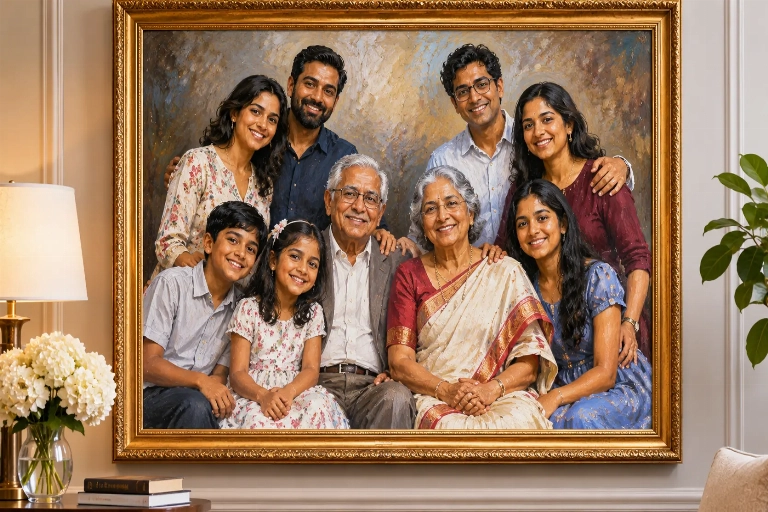
For a formal family portrait, the artist may arrange family members in rows or around a central figure. Parents might be positioned alongside or behind their children, while grandparents can be included in a way that gives the group a sense of connection.
For a more relaxed portrait, the composition may show people seated together, standing close to one another or interacting naturally. The choice depends on the available photographs and the atmosphere the customer wishes to create.
When individual photographs are used, the artist must consider how each person will appear in relation to the others. Differences in camera angle, lighting and perspective can make this challenging.
For example, a person photographed from a low angle may appear visually different from someone photographed at eye level. The artist needs to assess these differences when planning the arrangement and proportions.
The objective is to create a unified painting in which the figures appear to belong together, even if their original photographs were taken separately.
The background can be simple or detailed. A neutral or softly painted background helps keep attention on the family members, while a garden, home interior or outdoor landscape can add personal context.
Some customers prefer a background inspired by a meaningful family location, such as a former home, a favourite garden or a place associated with an important memory.
These details should be discussed before the painting begins because a more elaborate setting can affect the composition, size and amount of work required.
The style and medium influence the appearance, texture and atmosphere of a family portrait. The most suitable choice depends on the desired finish, level of detail, composition and the artist's specialist skills.
Oil painting is a popular choice for traditional family portraits because it allows artists to develop subtle tonal transitions, layered colour and detailed facial features. Oil paint can be worked gradually, making it suitable for carefully developing expressions, skin tones, clothing and background details.
Its versatility also makes it suitable for both realistic and more expressive portrait styles. The finished surface may contain delicate brushwork or more visible texture, depending on the artist's technique.
Oil painting requires careful working stages and appropriate drying time. A detailed portrait involving several people may take considerable time because each face, expression and relationship within the composition needs attention.
Watercolour creates a different visual character. Its transparent washes, softer edges and delicate layering can produce an elegant and expressive portrait.
Traditional watercolour requires specialist knowledge because the artist must manage the interaction between water, pigment and the painting surface. It is often developed differently from an oil portrait, and the approach needs to suit the level of detail and realism required.
Customers considering watercolour should discuss the intended surface, such as traditional watercolour paper, and the presentation or framing requirements before commissioning the work.
Watercolour portrait commissions can require considerable time and specialist artistic skill, particularly when accurate likeness and carefully controlled facial details are important. The artist's experience with the medium should therefore be considered when selecting this option.
Acrylic paint is a versatile water-based medium that dries relatively quickly and can be applied in thin layers or more textured passages. It can be used for realistic portraits, contemporary interpretations and paintings with stronger graphic or colour effects.
Its flexibility makes it suitable for different artistic approaches. The intended finish should be discussed with the artist so that the medium and technique are appropriate for the desired result.
Some families prefer a highly realistic portrait that closely follows their reference photographs. Others may prefer a softer, more painterly interpretation that captures the general likeness and atmosphere without reproducing every photographic detail.
It is important to establish these expectations before the commission begins. Discuss how closely the artist should follow the photographs, the desired degree of realism and any artistic interpretation you would welcome.
The dimensions of a family portrait should be considered in relation to the number of people, the composition and the intended display location. Size affects how much detail can be developed, particularly when the painting includes several faces.
Smaller paintings can work well for couples, parents with young children or compact compositions. They may be suitable for bedrooms, studies, smaller living spaces and personal display areas.
However, when several people are included, the artist needs sufficient space to represent each face clearly. The dimensions should be agreed with the artist rather than selected solely on the basis of the available wall space.
Larger canvases offer more room for multiple figures and detailed backgrounds. They can be particularly appropriate for multi-generational portraits or paintings intended to become a central feature in a living room or family home.
A larger format can also allow more flexibility when positioning family members, creating visual balance and including additional details such as pets, furniture or meaningful locations.
Canvas is commonly used for oil and acrylic paintings. Cotton canvas and linen canvas are two established options, each with different characteristics relating to texture, strength and surface preparation.
Linen is traditionally valued for its fine and stable surface, while cotton canvas is widely used and available in a range of textures and weights. The most suitable surface depends on the medium, the artist's technique and the intended finish.
For traditional watercolour, watercolour paper is generally the standard choice. Specialist watercolour surfaces are also available, but the artist should confirm that the selected material is appropriate for the intended technique.
The price of a family portrait depends on several factors. There is no single standard price because each commission has its own requirements, composition and level of artistic work.
Each additional person introduces further work. The artist must study the reference photographs, develop the facial features, consider proportions and position the figures within the overall composition.
Accurate likeness is particularly important in a family portrait. Each individual needs to be recognisable while remaining visually connected to the rest of the group.
Larger paintings generally require more materials and working time. They may also allow for more elaborate compositions, additional clothing detail and more extensive backgrounds.
The choice of oil, watercolour or acrylic can influence the price. The complexity of the requested style, the amount of detail and the specialist skills required also need to be considered.
A highly detailed realistic portrait may involve more work than a simpler, more expressive interpretation. Specialist techniques and materials can also affect the overall quotation.
A simple background will usually involve less work than a detailed interior, garden or landscape. Additional elements such as pets, furniture, meaningful objects and architectural features may also increase the time required.
Before confirming a commission, ask for a clear quotation that explains the agreed painting size, medium, number of people, composition, background, payment arrangements and delivery costs.
It is also helpful to establish whether framing is included or priced separately. International delivery, specialist packaging and insurance may affect the final cost.
A structured commissioning process helps ensure that the customer and artist share the same understanding of the finished artwork.
The process begins with an enquiry describing the portrait requirements. The customer can explain who should appear, the preferred style, approximate size, intended medium and any important details about the composition.
Reference photographs can then be provided for an initial assessment. The artist can consider whether the images are suitable and identify any additional photographs or information required.
Once the photographs have been reviewed, the composition and artistic direction can be discussed. This is the opportunity to clarify the arrangement, background, clothing, expressions and overall appearance.
It is important to resolve major compositional questions at this stage rather than leaving them until the painting is well advanced.
After the requirements have been assessed, the customer should receive a quotation outlining the agreed scope of work. This should cover the dimensions, medium, number of people, expected timescale and delivery arrangements.
The commission can then be confirmed in accordance with the artist's payment and booking arrangements.
The artist develops the portrait using the agreed references and composition. Depending on the medium and complexity, this may involve preparatory drawing, establishing the main forms, building colour and tone, developing facial features and refining the background.
Oil paintings may require several working stages and appropriate drying time between layers. Watercolour and acrylic follow different working processes, so the schedule will depend on the selected medium.
The customer should understand in advance what opportunities are available to review the work and at which stages feedback can be considered. Any agreed review process should be realistic and take account of the fact that a painting is an artistic creation rather than a digitally editable photograph.
Once the painting is completed, final checks can be made before it is prepared for collection or delivery.
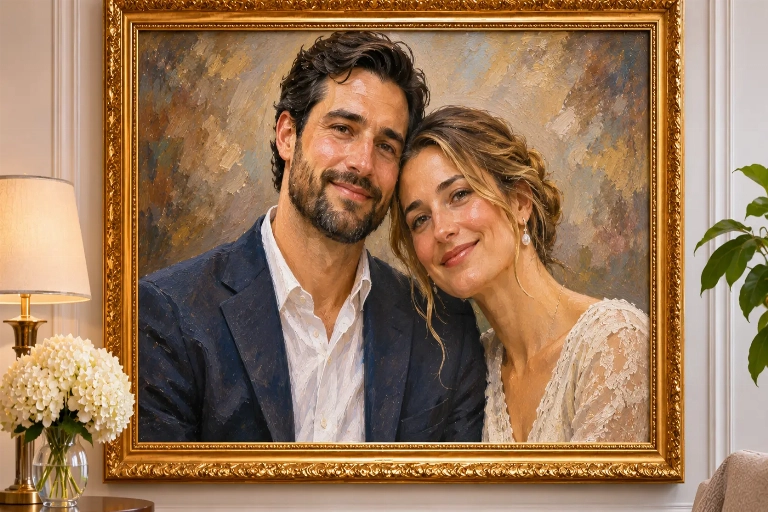
The time required depends on the number of people, painting size, medium, complexity and the artist's existing workload. A small portrait of two people will generally involve a different level of work from a large multi-generational family painting.
Oil paintings may require additional time because of the painting process and drying requirements. Traditional watercolour also requires specialist handling and careful planning, particularly where accurate likeness and detailed facial features are important.
Customers commissioning artwork for a birthday, anniversary, wedding or other special occasion should make enquiries well in advance. The estimated completion date should be discussed and agreed before the commission is confirmed.
Once the painting is finished, the next consideration is how it will be presented and displayed. Preparation requirements depend on the medium, size and whether the artwork is delivered framed or unframed.
A frame can complement the painting and help it sit comfortably within the intended interior. Traditional family portraits may suit classic wooden or decorative frames, while contemporary portraits can work with simpler, more understated designs.
If the painting is delivered unframed, the customer can choose a frame that suits the room and personal preferences. For works on paper, appropriate mounting and framing materials should be considered to help protect the artwork.
Paintings need suitable protection during transport. Packaging arrangements should take account of the artwork's dimensions, surface, framing and destination.
For larger paintings, rolled canvas delivery may be an option where the painting and medium are suitable. This requires appropriate preparation and subsequent stretching or mounting by a professional. It should not be assumed that every painting can be safely rolled.
For international orders, confirm the delivery method, packaging, insurance, customs arrangements and any additional charges before the artwork is dispatched.
Choose a position where the portrait can be appreciated without exposure to prolonged direct sunlight, excessive humidity or sudden temperature changes. Avoid placing artwork close to heat sources or areas where it may be damaged by frequent contact.
Follow any care guidance supplied by the artist, particularly for oil paintings that may require appropriate curing time before certain finishing or framing processes.
Careful preparation can prevent misunderstandings and help the artist produce a portrait that reflects the customer's expectations.
Commissioning a family portrait is an opportunity to turn personal memories and relationships into a lasting work of art. From selecting the right reference photographs to agreeing the composition, medium, size and background, each stage contributes to the finished painting.
The most successful commissions begin with clear communication. Customers should share their preferences, provide suitable photographs and discuss the intended style and level of detail. The artist can then assess the requirements, recommend an appropriate approach and explain the time and cost involved.
Whether the finished painting is a traditional family group, a relaxed portrait, a multi-generational composition or a memorial artwork, its value lies in the people and memories it represents. A carefully planned, hand-painted family portrait can become a meaningful centrepiece in the home and an artwork that can be appreciated by future generations.
The number depends on the requested dimensions, composition and level of detail. Larger canvases are generally more suitable for extended families and multi-generational portraits because they provide more space for each person to be represented clearly.
Yes. A memorial family portrait can be developed using suitable photographs of the person. The quality and clarity of the reference images will influence how accurately the artist can reproduce their likeness. The composition can be planned to bring the person together with other family members in a respectful and natural way.
Yes. Dogs, cats and other family pets can be included in a commissioned portrait. Provide clear photographs of the animals and discuss their position in the composition with the artist. The number of people, pets and overall dimensions will influence the planning and quotation.
Yes. The background can be simple, neutral or based on a meaningful location such as a family home, garden or favourite landscape. Discuss the preferred setting before the commission begins, as a detailed background can affect the composition, painting dimensions and amount of work required.
The opportunities for review and feedback should be agreed before the commission begins. It is important to confirm the composition, reference photographs and artistic direction in advance. Changes to major elements after painting has started may require additional work and could affect the timescale or cost.
At GFM Painting, each portrait commission begins with an understanding of the people, photographs and ideas behind the artwork. Whether you are planning a traditional family group, a multi-generational portrait, a family and pet painting or a memorial composition, the requirements can be discussed before the work is confirmed.
Share your reference photographs and preferred style to begin the process. The team can assess the project, discuss suitable artistic options and provide a quotation based on your requirements.
Websites Built to Grow Your Business
Professional Web Design • Development • SEO • Digital Marketing
Read More
Discover a different perspective on wealth, stewardship, purpose and leadership.
Read MoreA family portrait captures more than the appearance of the people within it. It preserves relationships, shared memories and moments that become increasingly meaningful over time.
From a traditional family group to a multi-generational composition, every commissioned portrait begins with a personal story and a vision of how it should be remembered.
Carefully selected photographs, thoughtful composition and the skill of a specialist artist bring individual faces and expressions together in one harmonious painting.
Whether created to celebrate a special occasion, remember loved ones or simply bring the family together through art, a hand-painted portrait offers something deeply personal.
More than a picture on the wall, a family portrait can become a treasured part of a family's history, appreciated today and passed down to future generations.
Frequently Asked Questions
Yes. An artist can use separate photographs to create one composition, provided the images show sufficient detail. The artist must consider differences in lighting, perspective, posture and proportions.
The number depends on the requested dimensions, composition and level of detail. Larger canvases are generally more suitable for extended families and multi-generational portraits.
Yes. A memorial family portrait can be developed using suitable photographs of the person. The quality and clarity of the reference images will influence how accurately the artist can reproduce their likeness.
Oil painting is a popular choice for detailed, traditional portraits. Watercolour offers a softer, more delicate appearance, while acrylic provides versatility and a range of contemporary finishes.
Yes. Pets can be incorporated into the composition alongside family members. Suitable photographs showing their facial features, markings and proportions will help the artist capture their appearance.

GFM Designer Ltd
Maultway Court
67-69 Ruxley Lane
Epsom, Surrey
KT19 0JG. UK

E-MAIL : info@gfmpainting.co.uk
PHONE : +44 (0) 203 592 3482
MOBILE : +44(0) 7834 393 396