Your favourites are only temporarily saved. To find them back, create your account on GFM Painting!
Already have account ?

No gift cards in your cart.
November 13, 2026


Few artists have influenced the visual imagination as profoundly as Vincent van Gogh. More than a century after his death, his paintings continue to appear in galleries, homes, design publications and contemporary interiors around the world. Their distinctive colours, expressive brushwork and emotionally charged compositions have become instantly recognisable, yet their appeal extends far beyond familiarity.
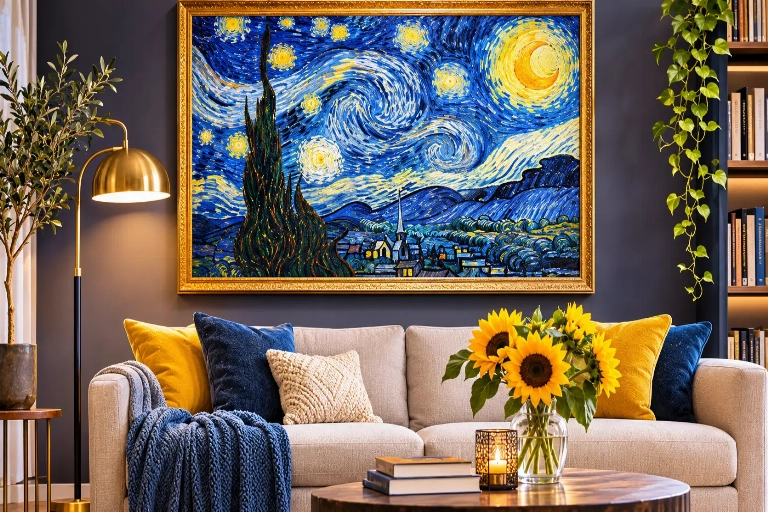
Van Gogh's paintings possess qualities that make them particularly compelling in modern living spaces. They combine strong visual structure with expressive movement, vivid colour with carefully considered composition, and recognisable subjects with an intensely personal interpretation. A painting such as The Starry Night can introduce drama into a minimalist room, while Sunflowers can bring warmth and vitality to a contemporary living area.
However, the relationship between Van Gogh's art and modern interior design is not simply a matter of choosing a famous image to decorate a wall. It is rooted in the artist's approach to colour, texture, atmosphere and visual expression. Understanding the historical development of his work helps explain why these paintings remain relevant and how they can be appreciated within contemporary homes.
Vincent van Gogh was born in the Netherlands in 1853 and became one of the most influential artists of the nineteenth century. Although he is now celebrated as a major figure in modern art, his artistic career was relatively short. He committed himself seriously to painting in his late twenties and developed his distinctive approach over approximately a decade.
Before becoming an artist, Van Gogh worked in an art dealership, taught and spent time as a missionary. His experiences shaped his interest in ordinary people, rural communities, work, nature and spiritual questions. These subjects remained important throughout his career.
His early paintings were often concerned with the lives of working people and the realities of rural existence. Rather than presenting idealised scenes of countryside life, he sought to communicate the physical effort and dignity of ordinary labour. His interest in human experience gave his paintings a seriousness that continued into his later portraits and landscapes.
Van Gogh's relationship with his brother Theo was also central to his development. Theo supported him financially and emotionally, while their extensive correspondence provides an important record of the artist's ideas, ambitions, working methods and difficulties. Through these letters, it is possible to understand that Van Gogh was not simply painting spontaneously. He thought deeply about artistic technique, colour, composition and the purpose of painting.
His work is now associated with Post-Impressionism, a broad term used for artists who developed individual approaches beyond the observational concerns of Impressionism. Van Gogh's paintings demonstrate how colour, line and form could communicate an artist's personal response to the world.
Van Gogh's artistic development is essential to understanding the visual character of his mature paintings. His style did not appear fully formed. It evolved through observation, experimentation, study and exposure to other artists.
During his early years as an artist in the Netherlands, Van Gogh concentrated on peasants, agricultural workers, cottages and rural landscapes. His palette was dominated by earthy browns, dark greens, muted greys and subdued tones. These colours reflected both the subjects he painted and his interest in the traditions of Dutch and northern European painting.
The Potato Eaters (1885) is one of the most important works from this period. It depicts a group of peasants gathered around a table, sharing a simple meal beneath the light of a lamp. The figures are deliberately presented with rough, weathered features and working hands, emphasising their connection with the land and the labour involved in producing their food.
The painting is very different from the bright landscapes and floral compositions for which Van Gogh later became famous. Its darker palette and concentrated atmosphere demonstrate his early interest in communicating the character and circumstances of his subjects rather than simply producing an attractive image.
In 1886, Van Gogh moved to Paris, where he encountered Impressionist and Neo-Impressionist painting. The city's artistic environment introduced him to new ideas about colour, light, brushwork and composition.
He studied the work of artists including Claude Monet, Camille Pissarro and Georges Seurat. He also became interested in Japanese woodblock prints, which influenced his approach to outlines, flat areas of colour, cropping and composition.
His palette became noticeably brighter. Dark, earthy colours gave way to more vivid combinations of blues, yellows, greens and reds. His brushwork also became more varied, with shorter strokes, dots and repeated marks contributing to the overall surface of a painting.
This period was important because it helped Van Gogh develop a visual language that was increasingly individual. He did not simply imitate the artists around him. He absorbed different influences and transformed them into a distinctive style.
Van Gogh moved to Arles in southern France in 1888. The landscape, sunlight, buildings and vegetation of Provence became major sources of inspiration. His paintings from this period demonstrate a more confident use of colour and composition.
He also hoped to establish a community of artists in the region. The Yellow House, which he rented in Arles, represented this ambition. His time there included a brief and difficult period of collaboration with Paul Gauguin, whose artistic philosophy differed from his own.
Some of Van Gogh's best-known works emerged during this period, including the Sunflowers series, The Bedroom and Café Terrace at Night. These paintings show how he could transform everyday subjects into images with strong emotional and decorative qualities.
In 1889, Van Gogh entered the asylum at Saint-Paul-de-Mausole in Saint-Rémy-de-Provence. Despite periods of illness and personal difficulty, he continued to paint and draw with considerable dedication.
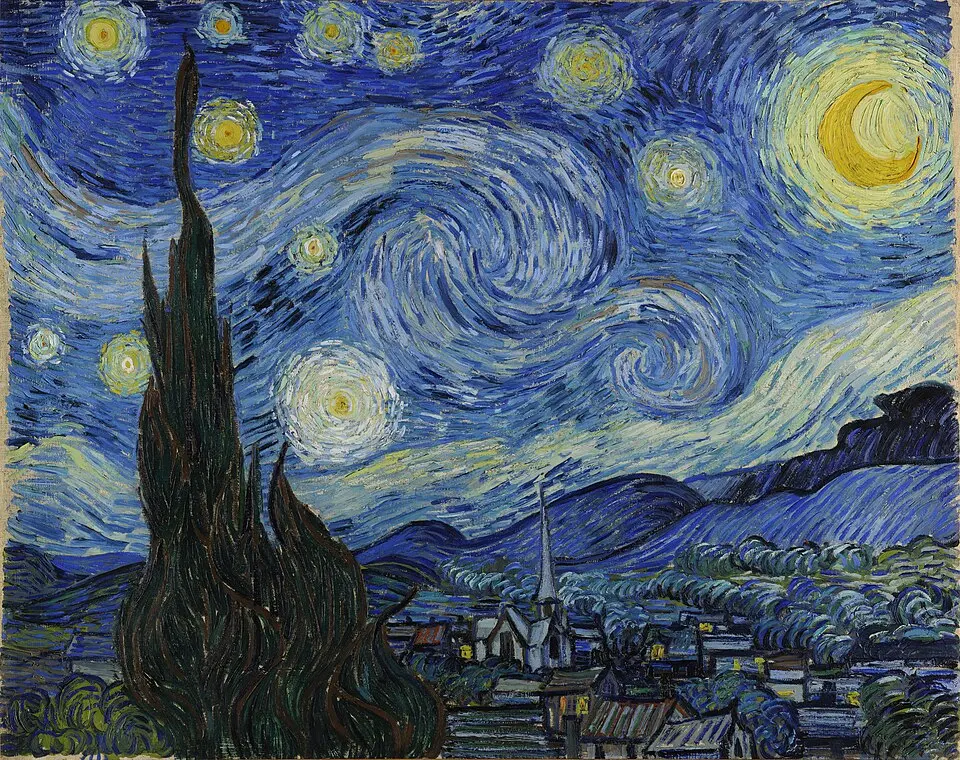
During this period, he produced some of his most celebrated landscapes, including The Starry Night (1889), as well as paintings of olive groves, cypress trees and gardens. His work increasingly explored the expressive possibilities of movement, rhythm, colour and repeated brushstrokes.
Van Gogh died in 1890, aged 37. His reputation grew substantially after his death, helped by the efforts of Theo's widow, Johanna van Gogh-Bonger, and the increasing recognition of his artistic achievements.
Van Gogh's paintings are often recognised immediately because several artistic characteristics work together to create a highly individual visual language. These qualities also explain why his work can have such a strong presence within contemporary interiors.
Van Gogh rarely attempted to conceal the physical marks made by his brush. Instead, he allowed individual strokes to remain visible, using their direction, length and rhythm to contribute to the composition.
In landscapes, curved strokes can suggest the movement of clouds, foliage or fields. In portraits, repeated marks can define facial features, hair and clothing. In floral paintings, the direction of the brushwork helps establish the form and energy of the flowers.
This visible movement gives his paintings a sense of life. Against the clean lines and smooth surfaces commonly found in modern furniture, the expressive marks create an appealing contrast.
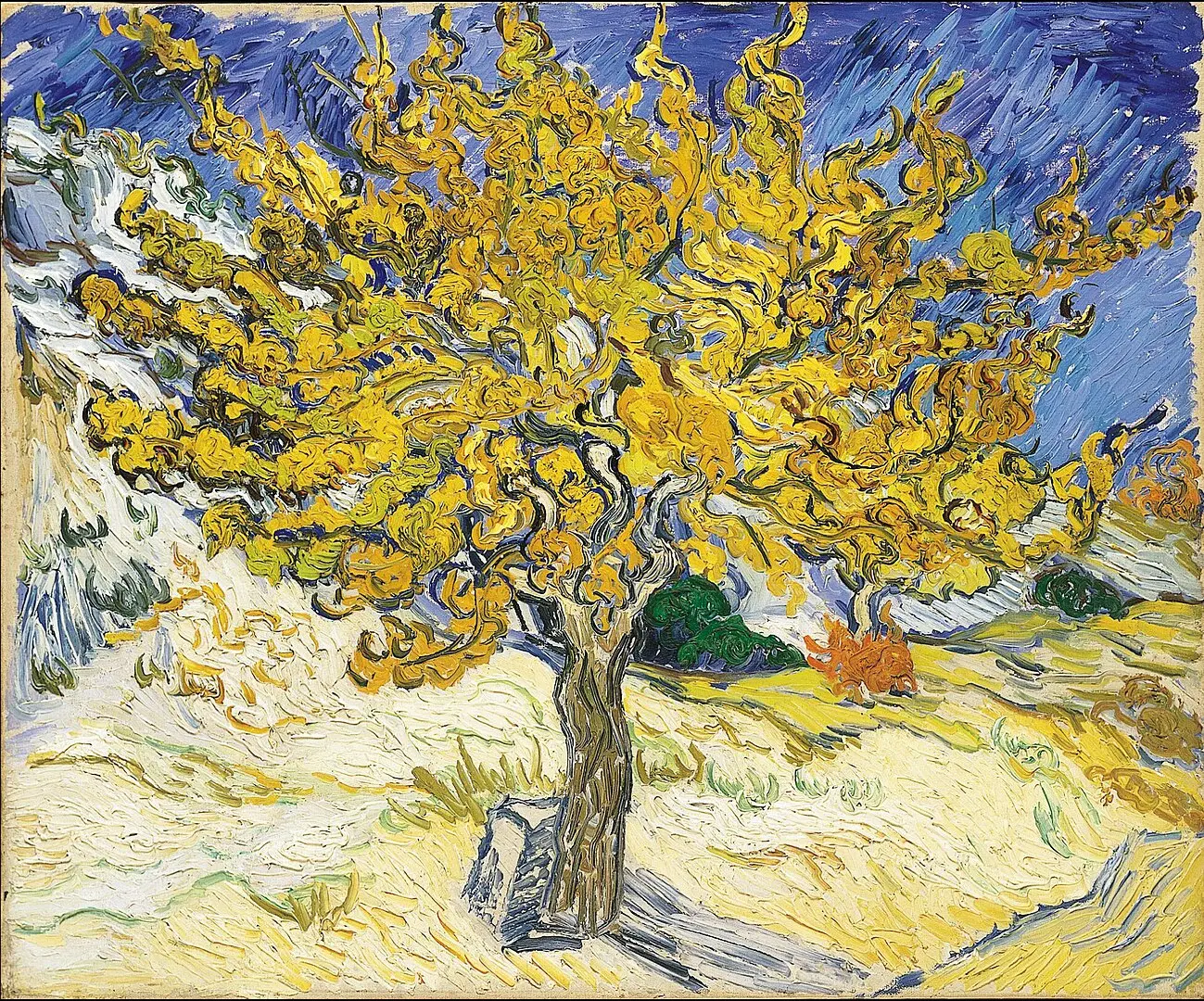
Impasto is a painting technique in which paint is applied thickly enough for brushstrokes or palette-knife marks to remain visible on the surface. Van Gogh used this approach in many of his oil paintings, creating areas of raised paint and strong surface texture.
In works such as The Starry Night, the direction and thickness of the paint contribute to the impression of movement. The surface becomes an important part of the image rather than simply a flat support for the composition.
When viewed closely, this texture reveals the physical process of painting. It also helps explain why a genuine hand-painted artwork can offer a different visual experience from a mechanically printed image. The surface, marks and application of paint become part of the work's character.
Colour was central to Van Gogh's artistic thinking. He understood that colour could do more than describe the appearance of an object. It could establish relationships, create contrast, guide the viewer's attention and communicate atmosphere.
He frequently explored complementary colours, particularly combinations such as blue and orange or yellow and violet. These relationships could make areas of a painting appear more vivid and create a strong sense of visual energy.
His use of colour was not always intended to reproduce nature literally. A face, landscape or night sky could be interpreted through colours selected for their expressive effect. This approach gave his paintings a distinctive emotional intensity.
Van Gogh's compositions are carefully structured, even when they appear energetic or spontaneous. He used strong directional lines, repeated shapes, contrasting areas and carefully positioned focal points to organise the viewer's experience.
In The Starry Night, the cypress tree, village, hills and swirling sky create a complex arrangement of vertical, horizontal and curved forms. In Sunflowers, the flowers are arranged within a compact composition that concentrates attention on their shapes, colours and changing stages of life.
This combination of visual organisation and expressive movement is one of the reasons his paintings work so effectively as focal points in modern rooms.
Van Gogh produced a wide range of paintings, from portraits and landscapes to still lifes and domestic interiors. Some works are particularly suitable for contemporary spaces because of their colour relationships, composition and visual character.
Painted in June 1889 while Van Gogh was staying at Saint-Rémy, The Starry Night is one of the most recognisable paintings in Western art. Its swirling sky, luminous stars, crescent moon and dark cypress tree create a dramatic composition.
The painting combines observation with imagination and memory. It was inspired partly by the view from the artist's surroundings, but the village and other elements were not simply copied from the scene visible through his window.
Its deep blues and contrasting yellows can work particularly well in contemporary interiors featuring neutral walls, charcoal furniture, natural wood or carefully selected blue accents. The painting's strong movement also provides contrast against simple architectural lines.
In a living room, it can function as a dominant focal point. In a study or reading area, its night-sky atmosphere can contribute to a more contemplative setting.
Van Gogh's Sunflowers paintings are among his most celebrated still lifes. He created several versions in Arles in 1888 and 1889, including paintings intended to decorate the Yellow House in preparation for Paul Gauguin's visit.
Yellow is central to these compositions. Van Gogh explored variations in tone, from bright golden shades to deeper ochres, using changes in colour and brushwork to give the flowers their visual presence.
The subject also carries a more complex meaning. The flowers appear at different stages of their life cycle, from fresh blooms to wilting heads. This introduces a subtle awareness of time, change and the temporary nature of beauty.
For modern interiors, the painting can bring warmth into spaces decorated with cream, beige, natural wood and soft grey. Its strong yellow tones can also provide a focal point in rooms that otherwise use a restrained palette.
Almond Blossom (1890) is one of Van Gogh's most delicate and recognisable compositions. The painting was created to celebrate the birth of his nephew, also named Vincent Willem, and was intended as a gift for his brother Theo and sister-in-law Jo.
The flowering branches are arranged against a blue background, drawing attention to their elegant structure and pale blossoms. The composition reflects Van Gogh's interest in Japanese art, particularly its use of cropping, simplified forms and decorative arrangements.
Its lighter palette makes it especially suitable for bedrooms, calm living areas and interiors with soft neutral colours. Unlike some of his more dramatic paintings, Almond Blossom can introduce artistic character without overwhelming the room.
Van Gogh painted several studies of irises during his stay at Saint-Rémy in 1890. These works demonstrate his interest in the relationship between colour, shape and decorative composition.
The flowers provide opportunities for strong contrasts, particularly between purple and yellow. The arrangement of individual blooms creates a rhythm across the picture, while the leaves and stems help establish movement.
An iris painting can complement contemporary interiors featuring blue, violet, white or muted green tones. It is particularly effective where floral artwork is desired without choosing a conventional photographic or highly realistic representation.
Painted in Arles in 1888, Café Terrace at Night depicts an illuminated café terrace beneath a deep blue evening sky. The contrast between warm artificial light and the surrounding darkness gives the composition its distinctive atmosphere.
The painting is an excellent example of Van Gogh's interest in the expressive possibilities of night scenes. Rather than treating darkness as an absence of colour, he explored the relationships between blue, yellow and other contrasting tones.
Its architectural setting and warm illumination can make it particularly suitable for dining rooms, hallways and living spaces designed to feel welcoming. It can also complement interiors featuring warm lighting, dark wood and understated Mediterranean influences.
The popularity of Van Gogh's paintings in contemporary interiors is not simply a consequence of their fame. Their visual qualities respond to several principles commonly found in modern design.
Minimalist interiors often use simple forms, uncluttered surfaces and restrained colour palettes. These choices can create a calm and spacious environment, but they may also leave large wall areas feeling visually empty.
A Van Gogh painting introduces movement, texture and colour without requiring the room to become heavily decorated. The artwork can provide a strong visual counterpoint to smooth walls, streamlined furniture and simple architectural details.
This contrast is particularly effective when the painting is allowed to stand on its own rather than being surrounded by numerous competing decorative objects.
Artwork can be one of the most flexible ways to introduce colour into an interior. A room with neutral walls and furniture can take on a different character through the addition of a painting with a strong palette.
For example, the blues and yellows in The Starry Night can be echoed through a small number of cushions or accessories. The warm tones of Sunflowers can complement wooden furniture, cream upholstery and natural materials.
The aim is not to reproduce the painting's entire colour scheme throughout the room. Instead, a few carefully selected complementary details can create a visual connection between the artwork and its surroundings.
Contemporary interiors often combine glass, metal, polished wood, stone and smooth fabrics. A painting with visible brushwork introduces a different kind of surface and a more personal form of expression.
Van Gogh's textured technique can make a room feel more individual because the artwork carries visible evidence of the artist's hand. It brings a sense of craftsmanship and artistic history into an otherwise contemporary setting.
Displaying historical art at home creates an opportunity to experience an important part of cultural heritage outside a museum or gallery. A familiar masterpiece can become part of everyday surroundings, inviting repeated attention and personal interpretation.
Its meaning may also change depending on the room, lighting and surrounding objects. This relationship between historical artwork and contemporary living is one of the most rewarding aspects of collecting or displaying art at home.
Even a beautiful painting may not achieve its full impact if it is poorly proportioned or positioned. The relationship between the artwork, wall and surrounding furniture should be considered before choosing a size.
A large painting can create a strong focal point above a sofa, fireplace or sideboard. However, it should relate comfortably to the width and height of the furniture beneath it.
Smaller works can be displayed individually in more intimate spaces or arranged as part of a gallery wall. When using a gallery arrangement, consider the overall shape created by the group rather than treating every frame as an unrelated object.
Living rooms, dining rooms, bedrooms and hallways can all provide suitable settings for Van Gogh-inspired artwork. The best position depends on how the room is used and where the painting can be viewed comfortably.
In a living room, a painting above the main sofa often becomes a natural focal point. In a dining area, a composition with warm colours or an architectural setting can help establish an inviting atmosphere. In a bedroom, a quieter subject and softer palette may be more appropriate.
Framing can influence whether a painting feels contemporary, traditional or somewhere between the two. A slim frame in black, dark wood or metal can create a restrained modern presentation. A more decorative gold-toned frame may emphasise the historical character of the subject.
The frame should complement the painting rather than distract from it. Consider the room's furniture, materials and existing finishes when making the final choice.
Good lighting helps reveal the painting's colours and surface details. Ambient lighting or a suitable picture light can enhance the display, but prolonged direct sunlight should be avoided because it can contribute to fading and deterioration.
Paintings should also be protected from excessive humidity, rapid temperature changes and unsuitable storage conditions. Appropriate care helps preserve the appearance and condition of the artwork over time.
When selecting Van Gogh artwork for a home, it is important to understand the difference between an original historical painting, a hand-painted reproduction and a printed image. These are distinct forms of artwork and should be described accurately.
An original Van Gogh painting is a work created by the artist himself during his lifetime. These works are historically significant and are held in museums, public collections and private collections. They are not equivalent to commercially available decorative reproductions.
For most people, experiencing an original Van Gogh painting means visiting a museum or gallery where the work is displayed and preserved.
A hand-painted reproduction is a new painting created by an artist using an existing artwork as a reference. It is not an original Van Gogh painting, but it can offer an opportunity to enjoy the composition, subject and artistic character of a famous masterpiece in a physical painted form.
The quality of a reproduction depends on the artist's understanding of the original, their painting skills, the materials used and the attention given to colour, composition, brushwork and surface texture.
A carefully executed hand-painted reproduction is an individual painting rather than a mechanically produced image. It may retain visible brushstrokes and paint texture, although it should never be represented as an original historical work.
A print reproduces an image through a mechanical or digital printing process. It can be an accessible way to display a famous composition, but it does not contain the individually applied brushwork of a hand-painted reproduction.
The choice between a print and a hand-painted reproduction depends on the buyer's priorities. Those who value the physical character of traditional painting may prefer an individually painted work, while others may prioritise affordability or a particular printed finish.
Van Gogh's influence extends beyond interior decoration. His work has become an important reference point in discussions about artistic individuality, emotional expression and the relationship between colour and meaning.
His paintings helped demonstrate that an artist did not have to reproduce the visible world in a strictly realistic manner to create a powerful image. Colour could be intensified, lines could become expressive and familiar subjects could be transformed through personal interpretation.
This approach continues to resonate with contemporary artists, designers and audiences. The expressive use of colour, visible brushwork and emphasis on individual artistic vision remain important features of many forms of modern painting.
His cultural influence is also reflected in exhibitions, books, films, educational programmes and the continued study of his letters and working methods. The popularity of his paintings has made them familiar across generations, but closer examination reveals a body of work that is more complex than a collection of instantly recognisable images.
For contemporary homeowners, this enduring influence offers another reason to display his work. A Van Gogh painting can provide an attractive focal point while also introducing a connection to the history and development of modern art.
Van Gogh's paintings continue to work in modern interiors because they bring together qualities that remain relevant to contemporary design: expressive colour, strong composition, distinctive texture and emotional depth.
His artistic development, from the darker rural scenes of the Netherlands to the vivid landscapes and still lifes of southern France, demonstrates a remarkable willingness to experiment and evolve. His use of brushwork, impasto, complementary colours and expressive forms created a visual language that remains instantly recognisable.
Whether it is the dramatic movement of The Starry Night, the warmth of Sunflowers, the delicate structure of Almond Blossom or the atmospheric character of Café Terrace at Night, each painting offers a different way to introduce artistic character into a home.
The most successful display is one in which the artwork has room to breathe and complements the character of the interior without losing its own identity. Historical art does not need to feel separate from contemporary life. With thoughtful selection and presentation, it can become part of the atmosphere, personality and everyday experience of a modern home.
Websites Built to Grow Your Business
Professional Web Design • Development • SEO • Digital Marketing
Read More
Discover a different perspective on wealth, stewardship, purpose and leadership.
Read MoreVincent van Gogh transformed familiar subjects into extraordinary works of art through expressive brushwork, bold colour and a deeply personal approach to painting.
From the swirling skies of The Starry Night to the golden brilliance of Sunflowers, his masterpieces continue to captivate audiences more than a century after they were created.
His artistic language offers a remarkable connection between historical painting and contemporary interior design, bringing movement, texture and individuality into modern spaces.
Whether displayed in a minimalist apartment, a traditional home or a contemporary living room, Van Gogh's work demonstrates how great art can transcend its original period.
A painting should do more than decorate a wall. It can tell a story, create an atmosphere and bring the enduring beauty of art history into everyday life.
Frequently Asked Questions
Van Gogh is associated with Post-Impressionism. Artists in this broad movement developed individual approaches that moved beyond Impressionism, using colour, form and expressive techniques to communicate personal interpretations of the world.
Van Gogh used colour to create visual contrast, structure and emotional expression. He explored complementary colour relationships and often selected colours for their expressive impact rather than simply reproducing natural appearances.
Impasto is a technique in which paint is applied thickly, leaving visible brushstrokes or raised textures on the surface. Van Gogh used it to give many of his paintings physical depth and expressive movement.
It depends on the room's colour scheme and atmosphere. The Starry Night offers dramatic blues and movement, Sunflowers introduces warmth, and Almond Blossom provides a lighter and more delicate appearance.
GFM Designer Ltd
Maultway Court
67-69 Ruxley Lane
Epsom, Surrey
KT19 0JG. UK
E-MAIL : info@gfmpainting.co.uk
PHONE : +44 (0) 203 592 3482
MOBILE : +44(0) 7834 393 396