
☰

November 12, 2026

GFM Painting Logo
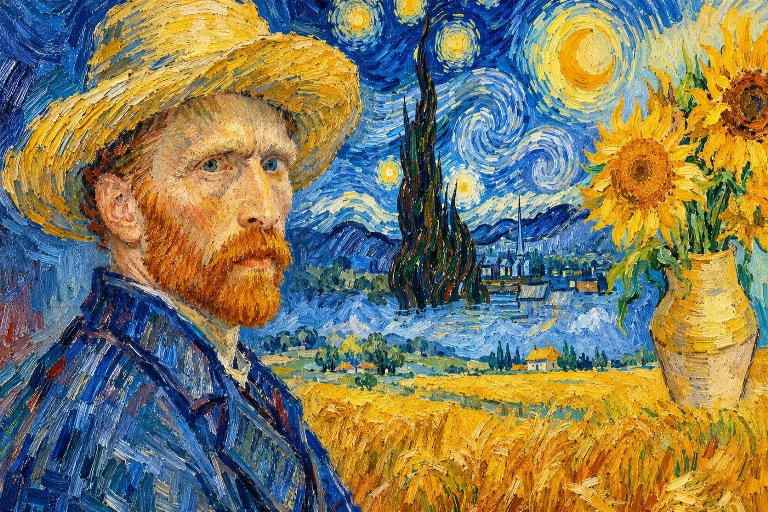
Expressive oil painting depicting Vincent van Gogh alongside a swirling blue night sky, vibrant sunflowers and golden wheatfields, illustrating his distinctive use of colour and energetic brushwork.

Vincent van Gogh (1853–1890) remains one of the most influential artists in the history of modern painting. Although his career as a painter lasted only around a decade, he developed a distinctive visual language that transformed the expressive possibilities of colour. His paintings are recognised for their vivid contrasts, energetic brushwork and powerful interpretations of the natural world.

Van Gogh's approach to colour did not emerge fully formed. It developed through years of experimentation, artistic study and exposure to new movements. His early paintings were dominated by earthy browns, muted greens and sombre tones, reflecting the rural subjects he initially explored in the Netherlands. Following his move to Paris in 1886, his palette became progressively brighter as he encountered Impressionism, Neo-Impressionism and Japanese prints.

In the south of France, particularly during his time in Arles, colour became an increasingly important means of artistic expression. Rather than simply reproducing the colours he observed, Van Gogh used them to communicate atmosphere, emotion and personal interpretation. His paintings demonstrate how colour can become an independent language within art.

Understanding Van Gogh's Use of Colour

How did Vincent van Gogh use colour in his paintings?

Van Gogh used colour to represent the world around him while also expressing emotion and personal interpretation. He experimented with complementary colours, strong contrasts, vivid tones and expressive brushwork to give his paintings distinctive visual energy.

Why did Van Gogh use such bright and contrasting colours?

Van Gogh was influenced by colour theory, Impressionism, Neo-Impressionism and Japanese prints. He believed that carefully selected colour combinations could create powerful visual effects and communicate emotions beyond realistic representation.

How did colour influence Van Gogh's artistic style?

Colour became central to Van Gogh's artistic identity. It helped him establish atmosphere, emphasise forms, create movement and communicate his response to nature, people and everyday surroundings. His increasingly expressive palette became one of the defining features of his work.

Introduction: The Artist Who Transformed Colour into Expression

Vincent van Gogh's artistic journey was shaped by a persistent desire to understand how painting could communicate more than physical appearance. He wanted to create works that reflected his experience of the world and the emotional qualities he discovered in everyday subjects.

Born in the Netherlands in 1853, Van Gogh initially explored subjects such as rural workers, landscapes and ordinary domestic life. His early paintings were influenced by the darker palettes of Dutch and Hague School painting. However, as he developed his artistic knowledge, he became increasingly interested in the expressive potential of colour.

His move to Paris in 1886 marked a major turning point. There he encountered the work of Impressionist and Neo-Impressionist artists and became familiar with new approaches to colour, light and brushwork. His interest in Japanese woodblock prints also influenced his use of strong outlines, simplified forms and unusual compositions.

These experiences gradually transformed his artistic vision. By the time he arrived in Arles in 1888, he had developed a much brighter palette and a more individual approach to painting.

Van Gogh's story is therefore not simply about an artist who used bright colours. It is about how an artist continually experimented with colour until it became one of the most recognisable elements of his creative identity.

1. From Darkness to Light: The Evolution of Van Gogh's Early Palette

Van Gogh's early paintings are considerably different from the vivid works for which he is best known. During his early artistic development in the Netherlands, he concentrated on rural communities, agricultural workers and the everyday realities of working life.

His palette was dominated by earthy colours, including:

  • Dark browns and ochres: Reflecting soil, wooden interiors and agricultural surroundings.
  • Muted greens: Representing fields, vegetation and rural landscapes.
  • Grey and blue-grey tones: Contributing to subdued atmospheric effects.
  • Deep reds and warm earth tones: Adding depth to figures and interior scenes.

One of the most important paintings from this period is The Potato Eaters (1885).

The Potato Eaters (1885): Representing Rural Life Through Earthy Colour

In The Potato Eaters, Van Gogh depicts a peasant family gathered around a table, sharing a simple meal. The figures are illuminated by a modest lamp, creating a dark and intimate atmosphere.

The predominantly brown and green palette reflects the humble conditions of rural life. Rather than presenting the figures as idealised subjects, Van Gogh sought to communicate the physical labour and difficult circumstances associated with peasant existence.

The painting also demonstrates his early interest in using colour to establish mood. Its subdued tones contribute to the seriousness of the subject and reinforce the connection between the figures and their environment.

Developing Beyond Traditional Representation

During this period, Van Gogh was still learning the technical foundations of painting. He studied drawing, perspective, figure construction and the representation of light and shadow.

His early work reveals an artist concerned with social reality and human experience. Although his palette would eventually become much brighter, the desire to communicate meaning through painting remained consistent throughout his career.

The transition from these darker works to his later compositions illustrates how significantly his understanding of colour evolved.

2. Paris and the Discovery of Colour: Influences That Changed His Art

Van Gogh moved to Paris in February 1886, joining his brother Theo, who worked in the art trade. The city exposed him to a rapidly changing artistic environment and introduced him to new ideas about painting.

He encountered the work of Impressionist artists, including Claude Monet and Camille Pissarro, as well as the emerging approaches of Neo-Impressionists such as Georges Seurat and Paul Signac.

These encounters encouraged him to reconsider his use of colour.

The Influence of Impressionism

Impressionist artists were interested in capturing the changing effects of light and atmosphere. Rather than relying entirely on dark outlines and carefully blended tones, they often used visible brushstrokes and brighter colours to represent the immediate appearance of a subject.

Van Gogh began experimenting with:

  • Brighter and more varied colour combinations.
  • Shorter, more visible brushstrokes.
  • Greater contrast between light and dark areas.
  • The use of colour to suggest changing light conditions.
  • Less dependence on traditional dark backgrounds.

The Influence of Neo-Impressionism

Neo-Impressionism introduced Van Gogh to more systematic approaches to colour. Artists such as Seurat explored how separate touches of colour could interact visually when viewed from a distance.

Van Gogh experimented with broken brushwork and contrasting colour combinations, although he did not adopt the strict methods of Pointillism.

Japanese Woodblock Prints

Japanese art also had a considerable influence on Van Gogh's development.

He collected Japanese prints with his brother Theo and admired their simplified forms, strong outlines, unusual viewpoints and distinctive colour arrangements.

Van Gogh studied and copied several Japanese prints, adapting elements of their visual language into his own paintings.

Their influence can be recognised through:

  • Strong contour lines around shapes.
  • Flattened areas of colour.
  • Unusual cropping and viewpoints.
  • Decorative patterns and simplified forms.
  • Strong relationships between foreground and background.

His exposure to these different artistic approaches helped him move beyond his earlier sombre palette and develop a more confident and experimental use of colour.

3. The Language of Contrast: Complementary Colours and Artistic Experimentation

One of the defining features of Van Gogh's artistic style was his use of colour contrast. He became particularly interested in complementary colours and how their relationships could create visual energy.

Complementary colours are positioned opposite one another on the traditional colour wheel. Common examples include:

  • Blue and orange.
  • Red and green.
  • Yellow and violet.

When placed alongside each other, complementary colours can intensify their visual presence and create a strong sense of contrast.

Van Gogh used these relationships to establish focal points, distinguish different areas of a composition and create emotional atmosphere.

Colour as a Deliberate Artistic Decision

Van Gogh did not always use colour to reproduce the exact appearance of an object. He frequently selected colours according to the effect he wanted to achieve.

For example, a landscape might contain stronger blues, yellows and greens than would appear in a strictly naturalistic representation. These choices helped communicate the intensity of sunlight, the character of the environment and his personal response to the subject.

Van Gogh's Chair (1888): Colour and Symbolic Expression

In Van Gogh's Chair, Van Gogh uses strong yellow and blue contrasts to establish the identity of the chair and create visual emphasis.

The painting can also be considered alongside Gauguin's Chair, which uses a different colour arrangement and atmosphere. Together, the two paintings demonstrate how objects can communicate artistic identity through colour and composition.

The National Gallery has highlighted the contrasting colour schemes of the two chairs and Van Gogh's growing interest in using colour symbolically.

His experiments demonstrate that colour was no longer simply a descriptive tool. It had become an essential part of how he constructed meaning within a painting.

4. Colour as Emotion: The Artistic Breakthrough in Arles

In February 1888, Van Gogh moved to Arles in the south of France. The brighter Mediterranean environment offered a new visual experience, with intense sunlight, vivid landscapes, flowering fields and distinctive architectural colours.

This period became one of the most productive and significant stages of his artistic career.

His palette developed further, incorporating brilliant yellows, vibrant blues, rich greens and expressive reds. Colour became increasingly important in communicating atmosphere and personal interpretation.

Sunflowers (1888–1889): Exploring the Power of Yellow

Van Gogh's Sunflowers series is among the most recognisable examples of his use of colour.

The paintings explore different shades of yellow, gold and ochre, creating a composition that appears to radiate warmth and light.

Rather than depending entirely on strong complementary contrasts, Van Gogh explored the expressive possibilities of variations within a single colour family.

The sunflowers also held personal significance. He intended the paintings to decorate the Yellow House in Arles in anticipation of Paul Gauguin's arrival.

The National Gallery notes that the brilliant yellow of the flowers was associated with happiness and the sunlit landscape of Provence.

The Bedroom (1888): Colour and the Search for Repose

In The Bedroom, Van Gogh used bold colour relationships to depict his private living space.

The painting features strong areas of blue, yellow, red and green. Its simplified forms and distinctive perspective create an unusual sense of visual structure.

Van Gogh explained that he wanted the painting to communicate a feeling of rest and tranquillity. His colour choices were therefore connected to an intended emotional effect rather than simply reproducing the exact appearance of the room.

The work illustrates how colour could be used to express an idea or desired atmosphere within an ordinary domestic subject.

Colour Beyond Natural Appearance

Van Gogh's paintings from Arles demonstrate an important development in his artistic thinking.

He increasingly treated colour as a means of expression in its own right. The colours in a painting did not always need to correspond precisely to the colours observed in nature.

Instead, they could communicate:

  • Emotional atmosphere and personal interpretation.
  • The intensity of sunlight and surrounding environment.
  • Relationships between objects and architectural forms.
  • Symbolic associations and visual contrasts.
  • The artist's individual response to a subject.

This approach helped establish the expressive character of his mature work.

5. Masterpieces Through Colour: Exploring Van Gogh's Most Influential Paintings

Van Gogh's most celebrated paintings demonstrate different aspects of his artistic understanding of colour. Each work reveals a particular combination of subject, composition, technique and expressive intention.

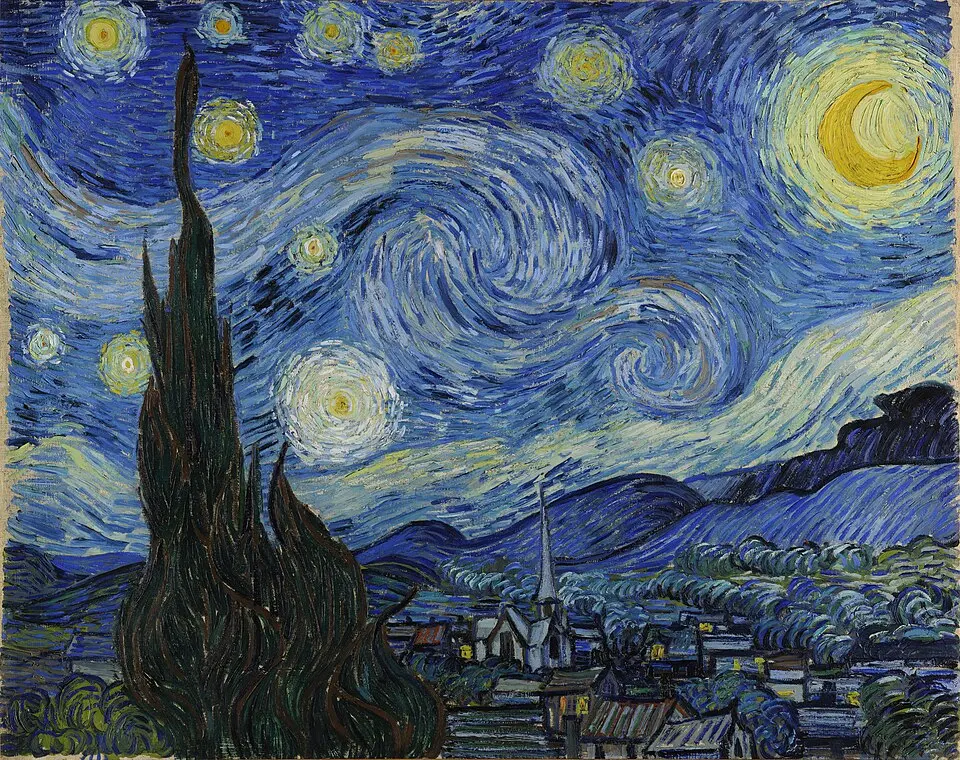
The Starry Night (1889)

Painted in June 1889 while Van Gogh was staying at the asylum in Saint-Rémy, The Starry Night is one of his most recognised works.

The painting features a dramatic night sky filled with swirling blue forms, luminous stars and a bright moon. A dark cypress tree rises in the foreground, connecting the landscape with the sky.

Its colour composition is dominated by blues and blue-greens, contrasted with the warm yellow and white of the stars and moon.

The movement of the brushwork gives the sky an extraordinary sense of energy. Colour and line work together to create a landscape that is both recognisable and highly personal.

Irises (1889)

Van Gogh painted Irises while staying at the asylum in Saint-Rémy.

The painting explores the distinctive forms of the flowers through a rich arrangement of blues, purples and greens. The individual flowers create a sense of rhythm across the composition.

His treatment of the subject demonstrates his ability to combine close observation of nature with expressive colour and decorative organisation.

The work also reflects his admiration for Japanese prints and their use of simplified forms and strong compositional relationships.

Café Terrace at Night (1888)

In Café Terrace at Night, Van Gogh explores the contrast between the warm yellow illumination of a café and the deep blue tones of the evening sky.

The composition demonstrates how complementary colours can create a striking visual relationship.

The bright terrace draws the viewer's attention, while the darker surrounding buildings and night sky establish depth and atmosphere.

Rather than treating darkness as an absence of colour, Van Gogh gives the night scene a rich and varied palette.

Wheatfield with Crows (1890)

Wheatfield with Crows is one of Van Gogh's final paintings.

The composition combines a vivid yellow wheatfield, dramatic blue sky and dark birds. Its expressive brushwork and strong colour contrasts create an intense visual experience.

The painting has often attracted interpretations relating to isolation and emotional difficulty. However, its precise meaning remains debated, and it is important not to treat a single psychological interpretation as established fact.

Its artistic significance lies partly in the forceful way Van Gogh combined colour, movement and composition to create a powerful landscape.

The Importance of Studying Individual Masterpieces

Looking closely at Van Gogh's paintings reveals that his use of colour was not governed by one fixed formula.

Across different subjects, he experimented with:

  1. Dominant colour families, such as the yellows in Sunflowers.
  2. Complementary contrasts, as seen in Café Terrace at Night.
  3. Expressive brushwork and movement, particularly in The Starry Night.
  4. Decorative arrangements and strong outlines, evident in Irises.
  5. Dramatic colour relationships within landscapes, as demonstrated by Wheatfield with Crows.

Each painting contributes to a broader understanding of his artistic development.

6. Beyond the Canvas: Van Gogh's Techniques, Legacy and Influence

Van Gogh's artistic identity was shaped not only by his choice of colours but also by the way he applied paint to the canvas.

His distinctive brushwork helped give his paintings their physical energy and expressive character.

Expressive Brushwork and Impasto

Van Gogh frequently used thick applications of paint, a technique known as impasto. This created raised surfaces that made individual brushstrokes visible.

His brushwork often followed the structure of the subject. Curving strokes could suggest movement in the sky, while shorter marks communicated the texture of vegetation, fields and flowers.

His techniques included:

  • Impasto: Thick paint applied to create texture and physical depth.
  • Directional brushwork: Strokes arranged to follow or emphasise the movement of forms.
  • Layering: Building colour through successive applications of paint.
  • Broken brushwork: Separate touches of colour placed alongside one another.
  • Expressive outlines: Strong contours used to define shapes and separate areas of colour.

These techniques helped create paintings that communicate energy through both their colour and physical surface.

Pigments and the Changing Appearance of Colour

An important aspect of Van Gogh's legacy is the scientific study of the materials he used.

Some pigments available to nineteenth-century artists were not stable over time. Exposure to light and other environmental conditions caused certain colours to fade or change.

For example, research into Van Gogh's paintings has revealed that some red pigments have faded, altering the appearance of colour combinations that were originally more vivid.

This means that the colours visible in some of his paintings today may not perfectly represent the appearance he originally intended.

The Van Gogh Museum has undertaken research into these changes, helping art historians and conservators understand how his paintings have evolved since they were created.

Van Gogh's Influence on Modern Art

Although Van Gogh achieved limited commercial success during his lifetime, his paintings became increasingly influential after his death.

His expressive approach to colour and brushwork helped inspire later generations of artists, particularly those associated with Fauvism and German Expressionism.

Artists were encouraged to consider colour as an independent expressive element rather than treating it solely as a means of representing the natural world.

His influence can be recognised in several developments in modern art:

  • Greater freedom in the use of colour.
  • More expressive and individual approaches to brushwork.
  • The use of colour to communicate emotion and atmosphere.
  • A move away from strict naturalistic representation.
  • Greater emphasis on the artist's personal interpretation of a subject.

Van Gogh's importance therefore extends beyond the individual paintings he created. His work helped demonstrate the possibilities of colour as a central language of modern artistic expression.

Conclusion: A Legacy Painted in Colour

Vincent van Gogh's artistic journey demonstrates how colour can transform the way we see and understand the world. From the subdued earth tones of his early Dutch paintings to the vivid yellows, blues and greens of his later masterpieces, his palette evolved through continuous observation, experimentation and artistic discovery.

His experiences in Paris introduced him to new approaches to colour, while his time in Arles and Saint-Rémy allowed him to develop a distinctive visual language. Through complementary contrasts, expressive brushwork and carefully considered compositions, he created paintings that communicated far more than the physical appearance of their subjects.

Works such as The Starry Night, Sunflowers, The Bedroom and Irises continue to demonstrate the extraordinary possibilities of colour in painting.

Van Gogh's legacy reminds us that art is not simply about reproducing what we see. It is also about interpreting, feeling and communicating. Through his use of colour, he transformed everyday subjects and natural landscapes into deeply personal artistic expressions.

His paintings continue to inspire artists and audiences because they reveal how colour, when used with imagination and purpose, can become one of the most powerful languages in art.

BEeyond the Brushstrokes: Van Gogh's Journey into the Language of Colour

Vincent van Gogh transformed the way artists approached colour, moving beyond the traditional representation of nature towards a more expressive and deeply personal visual language.

From the darker earth tones of his early Dutch paintings to the vibrant yellows, blues and greens of his later masterpieces, his palette evolved alongside his artistic experiences and influences.

Inspired by Impressionism, Japanese prints and colour theory, Van Gogh experimented with complementary colours, powerful contrasts and expressive brushwork to communicate more than the appearance of the world around him.

Paintings such as The Starry Night, Sunflowers, The Bedroom and Irises demonstrate how colour became central to his artistic identity, shaping the atmosphere, emotion and meaning of his compositions.

Discover how Van Gogh developed his extraordinary use of colour, challenged artistic conventions and created a visual legacy that continues to influence artists and captivate audiences worldwide.

Can't Find What You Are Looking For

Contact Us

Sign up to receive the latest news from GFM Painting via email, including exclusive offers and updates...

PORTRAIT & REPRODUCTION
| | | |
PORTRAIT & REPRODUCTION
Show prices in

GFM Designer Ltd
Maultway Court
67-69 Ruxley Lane
Epsom, Surrey
KT19 0JG. UK
E-MAIL : info@gfmpainting.co.uk
PHONE : +44 (0) 203 592 3482
MOBILE : +44(0) 7834 393 396

  • Copyright GFM Designer 2026
  • Company Registration : 07286936
| | | |
GFM Painting top
GFM Painting