Your favourites are only temporarily saved. To find them back, create your account on GFM Painting!
Already have account ?
No gift cards in your cart.
November 19, 2026


The size of a canvas plays an important role in the appearance, composition and visual impact of a hand-painted oil portrait. Choosing the right dimensions helps determine how the subject is presented, how much detail can be included and how the finished painting will complement its surroundings.
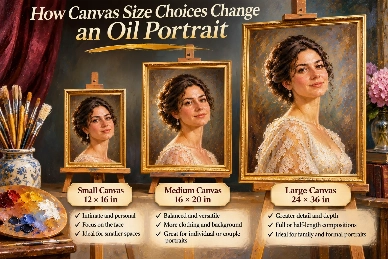
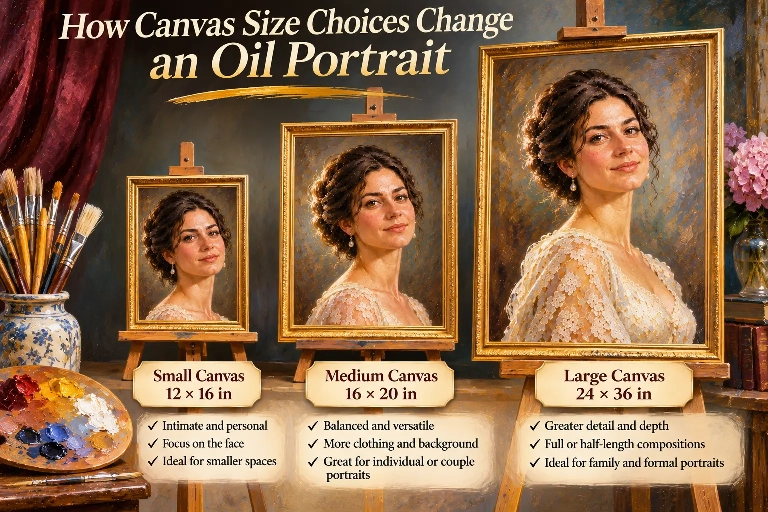
A smaller canvas can create an intimate portrait that draws attention to facial features and expression. A medium-sized canvas offers flexibility for individual and couple portraits, while a larger canvas provides more room for full-length figures, family groups, clothing details and elaborate backgrounds.
However, the largest canvas is not necessarily the best choice. The ideal dimensions depend on the photograph, number of subjects, composition, artistic requirements and intended display location.
Understanding how canvas size influences an oil portrait will help you make a more informed decision when commissioning a painting from a photograph.
Canvas size affects the composition, visual impact and level of detail that can be included in a hand-painted oil portrait. Smaller canvases create a more intimate appearance, while larger canvases provide greater space for detailed facial features, clothing, backgrounds and multiple subjects. The dimensions also influence how the painting will look when displayed.
The best canvas size depends on the subject and composition. Smaller dimensions may suit individual head-and-shoulders portraits, while larger canvases are often more appropriate for full-length portraits, couples and family groups. The chosen dimensions should provide enough space for the artist to represent the subjects naturally and maintain a balanced composition.
Yes. You can choose the dimensions for your commissioned oil portrait. It is important to consider the original photograph, number of subjects, desired composition and available wall space before selecting the final size. Discussing these factors with the artist can help establish the most suitable dimensions for the painting.
Canvas dimensions influence the entire painting process, from the initial arrangement of the subject to the placement of background details.
A portrait is not simply enlarged or reduced without affecting its composition. The artist must consider the proportions of the canvas, the available space around the subject and the relationship between the different elements within the painting.
A well-chosen canvas size allows the subject to remain the central focus while providing sufficient space for the composition to develop naturally.
Smaller canvases are particularly suitable for intimate portraits where the main emphasis is on the face and expression.
A head-and-shoulders composition can work beautifully on a compact canvas because it concentrates attention on the subject rather than extensive surroundings.
Smaller portraits offer several advantages:
However, smaller dimensions provide less room for elaborate backgrounds, detailed clothing and additional subjects. The artist must carefully manage the composition to ensure that facial features and important details remain clear.
Medium-sized canvases offer a balance between the intimacy of a smaller portrait and the visual impact of a larger painting.
They are often suitable for individual portraits, couples and compositions that include the upper body or some surrounding background.
A medium canvas can provide enough room to include:
This size category is particularly useful when you want the portrait to have a noticeable presence without occupying an entire wall.
Large canvases create opportunities for more expansive and visually striking portraits.
The additional surface area allows the artist to develop the composition with greater attention to clothing, posture, hands, surroundings and background details.
Large portraits are particularly suitable for:
A larger canvas can give the subject a stronger visual presence, particularly when displayed in a spacious living room, hallway or formal reception area.
However, a large painting needs sufficient wall space and an appropriate setting. The dimensions should complement the room rather than overwhelm it.
Different portrait compositions require different amounts of space. The number of people, their positioning and the amount of background included all influence the dimensions that may be appropriate.
| Portrait type | Illustrative canvas size | Typical composition |
|---|---|---|
| Individual head-and-shoulders | 12 × 16 inches | Close-up portrait |
| Individual upper-body portrait | 16 × 20 inches | Head and upper body |
| Individual half-length portrait | 20 × 24 inches | More clothing and background |
| Couple portrait | 24 × 30 inches | Two subjects together |
| Family portrait | 30 × 40 inches | Multiple people |
| Full-length portrait | 24 × 36 inches or larger | Full figure and surroundings |
These dimensions are illustrative rather than fixed recommendations. The most suitable size will depend on the photograph, canvas proportions, number of subjects and intended composition.
A painting featuring several people may need a larger canvas to ensure that each individual is represented clearly. Conversely, a close-up portrait may look more effective on a smaller canvas where the face becomes the main visual feature.
Canvas orientation is another important consideration when selecting the dimensions of a commissioned portrait.
A vertical canvas is often suitable for individual portraits, full-length compositions and formal paintings. It naturally draws attention to the subject's face and body while allowing room for the figure to be presented from head to toe.
A horizontal canvas can be more suitable for couples, family groups and compositions where subjects are positioned alongside one another. It also provides additional room for landscapes, interiors and surrounding details.
Square canvases can create a balanced and contemporary composition. They can be particularly effective for certain close-up portraits and arrangements where the subject is positioned centrally.
The orientation should complement the photograph and intended composition. A photograph that is naturally horizontal may require careful adjustment if it is to be painted on a vertical canvas.
The amount of available canvas space influences how the artist can develop individual features.
On a smaller canvas, the composition may need to concentrate on the most important elements, such as the face, eyes and expression. Fine details in clothing, jewellery and surrounding objects may receive less emphasis.
Larger canvases provide more room to develop:
A larger canvas does not automatically guarantee a better painting. The quality of the artwork depends on the artist's skill, technique and attention to detail. However, suitable dimensions can give the artist greater flexibility when developing a complex composition.
When commissioning a portrait featuring two or more people, canvas size becomes particularly important.
Each subject needs sufficient space to be represented clearly, with appropriate proportions and a natural relationship to the other people in the composition.
A canvas that is too small may make the figures appear crowded, particularly when the painting includes several people or detailed clothing.
For a family portrait, consider:
A larger canvas may be appropriate for multi-generation portraits or family compositions containing several subjects. The final dimensions should allow the artist to maintain a natural arrangement without making the figures appear compressed.
The background is an important part of the overall composition. It can establish the atmosphere, provide context and complement the subject.
A smaller canvas may work best with a simpler background that does not compete with the portrait. A larger canvas can accommodate more elaborate surroundings, including interiors, gardens, landscapes and architectural details.
For example, a traditional formal portrait may include a relatively understated background, while a heritage portrait could incorporate a meaningful location or decorative surroundings.
The background should support the subject rather than distract from it. Selecting the right canvas proportions gives the artist more flexibility to balance the foreground and background.
The intended display location should be considered before deciding on the canvas dimensions.
A painting that looks impressive in a studio may appear too large or too small when placed in a particular room.
Before commissioning your portrait, consider the following:
It can be helpful to mark out the proposed canvas dimensions on the wall using masking tape. This provides a simple visual reference before making a final decision.
Yes. A photograph can sometimes be adapted to suit different canvas dimensions, but the process requires careful consideration of the original image and intended composition.
For example, a photograph taken in portrait orientation may not translate directly into a wide landscape canvas. The artist may need to adjust the positioning of the subject or consider how additional background space can be incorporated.
Possible adjustments include:
The important consideration is maintaining the subject's natural proportions and appearance. Any compositional changes should enhance the painting without making the subject look distorted or unnatural.
Selecting unsuitable dimensions can affect the final appearance of a portrait. A few common mistakes are worth avoiding.
A detailed family portrait or full-length painting may require more space than initially expected.
The original photograph's orientation and proportions should influence the choice of canvas.
A composition that includes elaborate surroundings may need additional canvas space.
The dimensions should be suitable for the room where the painting will be displayed.
A larger painting is not necessarily more appropriate. The dimensions should suit the subject, composition and intended visual effect.
Before confirming your commission, consider the following steps:
The most successful choice is one that brings together the subject, composition and intended display space.
Canvas size plays an important role in the appearance and presentation of a hand-painted oil portrait. Smaller canvases can create intimate and personal artwork, medium sizes offer versatility, and larger canvases provide greater scope for elaborate compositions and multiple subjects.
The ideal dimensions depend on what you want the painting to communicate, the number of people included, the level of background detail and where the finished artwork will be displayed.
At GFM Painting, we create hand-painted oil portraits from photographs, with attention to composition, proportion, expression and artistic detail. Choosing an appropriate canvas size is an important first step towards creating a portrait that you will treasure for years to come.
Thinking about commissioning a hand-painted oil portrait? Explore the possibilities with GFM Painting and consider the canvas dimensions that will best present your chosen photograph.
Websites Built to Grow Your Business
Professional Web Design • Development • SEO • Digital Marketing
Read More
Discover a different perspective on wealth, stewardship, purpose and leadership.
Read MoreCanvas size plays an important role in the appearance and composition of a hand-painted oil portrait.
Small canvases create intimate portraits, while medium dimensions offer flexibility for individual and couple compositions.
Large canvases provide greater space for full-length figures, family groups, detailed clothing and elaborate backgrounds.
The right dimensions depend on the subject, photograph, composition and intended display location.
Discover how to choose the ideal canvas size for a commissioned oil portrait that balances artistic detail, proportion and visual impact.
Frequently Asked Questions
The best canvas size depends on the desired composition. A smaller canvas, such as 12 × 16 inches, may suit a head-and-shoulders portrait, while a larger size can accommodate more of the upper body, clothing and background.
A larger canvas provides more space for the artist to develop details such as facial features, hair, clothing, hands and backgrounds. However, the quality of the finished portrait depends on the artist's skill and technique, not simply the canvas size.
The appropriate size depends on the number of family members, their positioning and whether the painting includes full-length or upper-body figures. A larger canvas may be preferable for several subjects to ensure that everyone is represented clearly.
Yes. You can choose dimensions that complement your intended display location. Consider the available wall space, surrounding furniture, viewing distance and whether you intend to frame the painting.
Yes. Portrait-oriented canvases are often suitable for individual and full-length portraits, while landscape-oriented canvases can work well for couples and family groups. Square canvases can also create balanced compositions for certain close-up portraits.

GFM Designer Ltd
Maultway Court
67-69 Ruxley Lane
Epsom, Surrey
KT19 0JG. UK

E-MAIL : info@gfmpainting.co.uk
PHONE : +44 (0) 203 592 3482
MOBILE : +44(0) 7834 393 396