☰

November 19, 2026

GFM Painting Logo
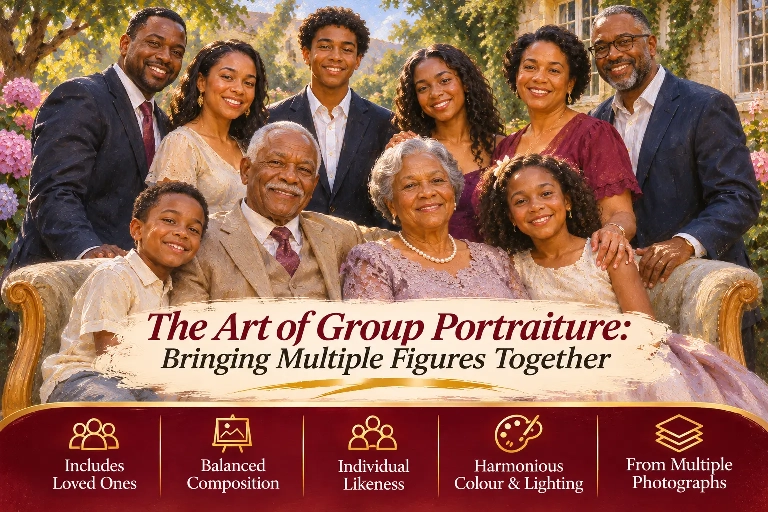
Multigenerational family oil portrait showing grandparents, parents and children arranged together in a garden setting, illustrating group composition, individual likeness and family connections.

Including multiple people in an oil portrait creates an opportunity to capture relationships, shared memories and meaningful moments within a single painting. Unlike an individual portrait, a painting featuring several figures requires careful consideration of positioning, proportions, expressions, clothing and the relationship between each person. Every figure needs to be represented naturally while contributing to a balanced and harmonious composition.

Whether you are commissioning a couple's portrait, a family painting, a multi-generation portrait or an artwork featuring several loved ones, the arrangement of the figures plays an important role in the finished result. The choice of poses, spacing, background and canvas dimensions can influence how the painting communicates connection, personality and emotion.

How Do Multiple Figures Affect an Oil Portrait?

Multiple figures influence the composition, balance, scale and emotional character of an oil portrait. The artist must arrange each person so that everyone is clearly represented while maintaining natural proportions and a visual connection between the subjects. A successful group portrait communicates both individual identity and the relationship between the people portrayed.

What Is the Best Arrangement for Multiple Figures in an Oil Portrait?

The best arrangement depends on the number of people, their relative heights, the desired style and the available canvas space. Figures can be positioned standing, seated, side by side or in several rows. The most effective arrangement creates visual balance, allows every face to remain visible and gives the group a natural sense of togetherness.

Can Multiple People from Different Photographs Be Combined into One Oil Portrait?

Yes. Reference photographs can be used to bring several people together in one composition, even when they were photographed separately. Different images may provide the facial features, expressions, poses or clothing of individual subjects. The final arrangement should maintain consistent proportions, lighting and perspective so that everyone appears naturally connected.

Understanding the Challenges of Painting Multiple Figures

Creating an oil portrait with several people involves more than simply reproducing individual faces. The artist must consider how the figures relate to one another and how they fit within the overall composition.

Each person has individual facial characteristics, body proportions, posture and expression. These features need to be represented accurately while ensuring that the group looks unified. Differences in height, age and physical positioning also influence the arrangement.

The artist must pay attention to the visual relationship between subjects. A family portrait, for example, should communicate a sense of connection rather than appearing as a collection of separate individual portraits placed together.

Arranging Multiple Figures: Creating a Balanced Composition

The positioning of people is one of the most important decisions when planning a group oil portrait. The arrangement determines how the viewer's attention moves across the painting and how the relationships between the subjects are communicated.

Side-by-Side Composition

A side-by-side arrangement places people alongside one another, often at a similar height. This creates a straightforward and balanced composition that is particularly suitable for couple portraits and smaller family groups.

The subjects may face the viewer directly or turn slightly towards one another. Their positions should feel natural, with enough space between them to distinguish each figure while maintaining a sense of connection.

Seated and Standing Arrangements

Combining seated and standing figures introduces variation in height and creates a more dynamic group composition. Adults may stand behind seated family members, while children can be positioned in front or beside their parents.

This arrangement is often effective for larger family portraits because it uses vertical space efficiently. It also creates opportunities for natural interactions, such as a hand resting on a shoulder or family members standing close together.

Multi-Row Composition

For larger groups, arranging people in two or more rows can create a structured composition. The back row may include standing adults, while the front row contains seated subjects or children.

Careful positioning is essential to ensure that every face remains visible. Heads should not overlap awkwardly, and the arrangement should avoid making individuals appear hidden behind others.

Informal and Natural Arrangements

An informal composition can make a group portrait feel more personal and relaxed. People may sit close together, turn towards one another or interact naturally rather than adopting identical formal poses.

This approach is particularly suitable for family portraits where the intention is to capture warmth, affection and everyday relationships.

Individual Likeness: Preserving Each Person's Identity

One of the greatest challenges in a multi-figure oil portrait is ensuring that every individual remains recognisable. Each face has distinctive features, including eye shape, facial proportions, complexion, hairstyle and expression.

When several people appear in the same painting, it is important not to lose these individual characteristics through excessive simplification. Each subject deserves careful attention, even when some faces occupy less space than others.

Reference photographs should provide sufficient facial detail to help the artist understand the appearance of each person. Where possible, clear photographs showing the face from a suitable angle are particularly useful.

Differences in Height, Age and Body Proportions

Group portraits often include people of different ages and physical proportions. Adults, teenagers, young children and older family members may all appear together within the same composition.

The artist needs to preserve realistic differences in height and body structure. Children should not appear disproportionately large compared with adults, and the relative scale of each figure should remain consistent with the intended arrangement.

Posture also influences the composition. A standing person, a seated adult and a young child naturally occupy different amounts of space. Their positions should be planned carefully so that the finished painting feels balanced rather than crowded.

Capturing Relationships Through Body Language

Body language is particularly important when painting multiple figures. The way people stand, sit, turn towards one another or make physical contact can communicate the relationship between them.

In a family portrait, a parent placing a hand on a child's shoulder may suggest affection and reassurance. In a couple's portrait, standing close together or holding hands can communicate intimacy and connection.

For multi-generation portraits, the arrangement may emphasise family bonds through the positioning of grandparents, parents and grandchildren. These gestures help turn a group painting into a meaningful representation of shared relationships.

Expressions and Eye Direction: Creating a Sense of Connection

Facial expressions contribute significantly to the atmosphere of a group portrait. A painting in which everyone has a natural and complementary expression can feel warm and harmonious.

Subjects do not necessarily need to look in exactly the same direction. Some may face the viewer, while others may look slightly towards a family member. However, the overall arrangement should feel intentional rather than visually disconnected.

Subtle differences in expression can preserve the personality of each individual. A child's natural smile, a parent's relaxed expression or a grandparent's gentle gaze can all contribute to the character of the finished painting.

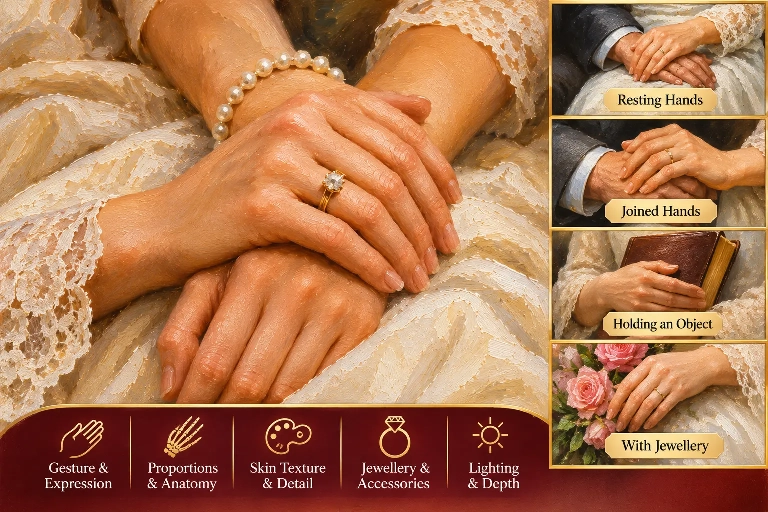
Hands and Physical Interaction Between Figures

Hands often play an important role in group portraits because they can communicate relationships and physical connection. People may hold hands, place an arm around another person, rest a hand on a shoulder or interact with children.

These gestures require careful attention to anatomy, proportions and positioning. The hands should appear naturally connected to the arms and bodies, while their placement should support the intended relationship between the subjects.

In larger compositions, overlapping arms and hands can introduce additional complexity. Clear reference photographs and thoughtful planning help ensure that these details remain convincing.

Clothing and Colour Coordination in Group Portraits

Clothing influences the visual balance of a multi-figure oil portrait. Different colours, fabrics and patterns can create variety, but they should work together harmoniously.

Some families prefer coordinated clothing, such as complementary neutral shades or similar colour palettes. Others prefer individual outfits that reflect each person's personality.

The artist should consider how the colours interact across the canvas. A strong colour in one part of the composition may need balancing elsewhere, while similar tones can help visually connect the subjects.

Clothing details should also reflect the reference photographs accurately, particularly when the garments have sentimental or personal significance.

Background Choices for Multiple Figures

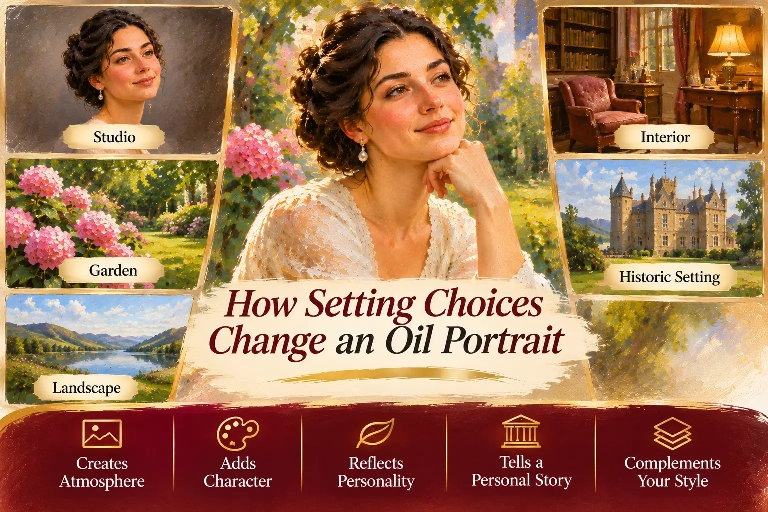
The background can help unify several people within one painting. A simple studio background creates a formal presentation, while a garden, family home or landscape can provide additional context and meaning.

For larger groups, the background should provide sufficient visual space without competing with the subjects. Excessive decorative details can make the composition feel crowded, particularly when several faces and figures already occupy the canvas.

A softly painted background may be effective because it provides atmosphere while keeping attention on the people. More detailed settings can also work when the environment has personal significance.

Lighting and Shadows Across Multiple Subjects

Consistent lighting is essential when several people appear in the same painting. The direction and intensity of light should make sense across every face and figure.

Highlights and shadows help define facial features, clothing and body proportions. They also create depth and separate overlapping figures from one another.

When subjects are taken from different photographs, the original lighting may not match. The artist must interpret these differences and establish a consistent lighting approach for the final composition.

This helps prevent the painting from appearing as though each person was photographed in a completely different environment.

Choosing the Right Canvas Size for Multiple Figures

Canvas size becomes particularly important as the number of people increases. Every additional figure requires sufficient space for the face, body and surrounding composition.

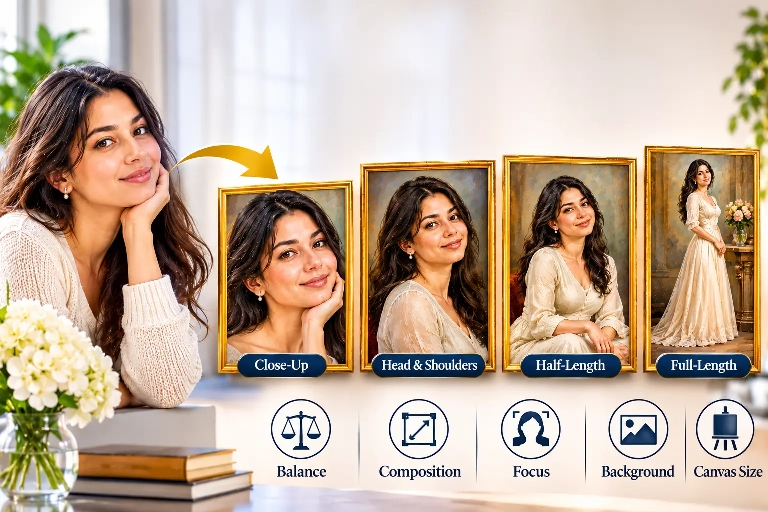
A small canvas may work for a close-up portrait of two people, but a larger family group generally requires more room. The chosen dimensions should allow faces to remain clearly visible without making the figures appear crowded.

Landscape-oriented canvases are often suitable for larger groups arranged horizontally, while portrait-oriented canvases may work for taller compositions with several rows of people.

The canvas dimensions should be considered alongside the number of subjects, their poses and the amount of background detail required.

Individual, Couple, Family and Multi-Generation Portraits

Couple Portraits

Couple portraits focus on the relationship between two people. Their positioning, expressions and gestures should communicate connection while preserving the individual identity of each subject.

Family Portraits

Family portraits bring several generations or members of a household together in one composition. The arrangement should provide enough space for everyone while communicating warmth and togetherness.

Multi-Generation Portraits

Multi-generation portraits can include grandparents, parents, children and grandchildren. These paintings often carry considerable sentimental value because they preserve the appearance of several generations within a single artwork.

Differences in age, height and posture must be considered carefully, with particular attention to the positioning of older family members and young children.

Group and Commemorative Portraits

Group portraits can also commemorate important occasions, friendships, professional relationships or shared experiences. The composition should reflect the significance of the people and the occasion while maintaining a clear visual structure.

Combining Multiple Photographs into One Painting

It is not always possible to find one photograph in which everyone looks their best. One person may have a better expression in one photograph, while another may be more clearly visible in a different image.

Using several reference photographs can provide greater flexibility when planning the composition. Separate images may be used to establish individual facial features, clothing, poses and expressions.

The challenge is ensuring that the combined figures look as though they belong together in one setting. Scale, lighting, perspective, colour and positioning should be considered consistently.

Clear reference images are particularly valuable when the subjects were photographed at different times or in different locations.

Common Mistakes to Avoid in Multi-Figure Oil Portraits

  • Overcrowding the composition: Too many figures in a limited space can make faces and bodies difficult to distinguish.
  • Incorrect proportions: Differences in height, age and body size should be represented naturally.
  • Hidden faces: Every subject should be clearly visible and appropriately positioned.
  • Inconsistent lighting: The figures should appear to share a coherent lighting environment.
  • Unnatural spacing: People should not appear disconnected or awkwardly separated.
  • Identical expressions: Individual expressions help preserve personality and make the painting feel natural.
  • Unconvincing hand positions: Interactions between figures should be anatomically and visually believable.
  • Unsuitable canvas dimensions: The canvas must provide enough space for the number of subjects and the intended composition.
  • Excessive background detail: The setting should support the group rather than compete with it.

How to Prepare for a Commissioned Multi-Figure Oil Portrait

Planning a multi-figure portrait begins with selecting suitable reference photographs and deciding how the subjects should be arranged.

Before commissioning the painting, consider the following:

  • Confirm how many people should appear in the portrait.
  • Choose clear reference photographs for each individual.
  • Decide whether the subjects should be standing, seated or arranged in several rows.
  • Consider the relationships and gestures you want the painting to communicate.
  • Choose the clothing and colour arrangement for the group.
  • Decide whether you prefer a simple background or a meaningful setting.
  • Consider the canvas dimensions required to accommodate everyone.
  • Identify any important details, accessories or personal objects that should be included.

Providing clear references and a considered arrangement helps establish the artistic direction and supports a more cohesive finished portrait.

Conclusion: Bringing Multiple Figures Together in One Meaningful Oil Portrait

A multi-figure oil portrait requires careful planning to bring several individuals together in a single harmonious composition. The positioning of each person, their proportions, expressions, clothing and interactions all contribute to the character of the painting.

Whether the artwork features a couple, a family or several generations, the aim is to preserve each person's identity while communicating the relationships that connect them. Thoughtful composition, consistent lighting and suitable canvas dimensions help create a painting that feels natural and balanced.

At GFM Painting, multiple reference photographs can provide the foundation for creating a personalised hand-painted portrait. By considering the individual characteristics of each subject and the relationships between them, a collection of photographs can be brought together to create a meaningful work of art that celebrates family, friendship and shared memories.

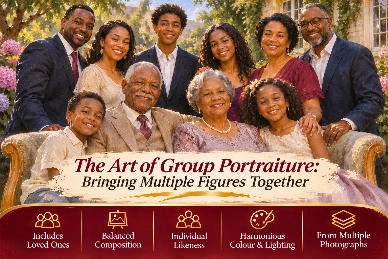
The Art of Group Portraiture: Bringing Multiple Figures Together

A multi-figure oil portrait brings family members, couples or loved ones together in one meaningful work of art.

Thoughtful positioning, natural poses and balanced spacing ensure that every individual is clearly represented.

Accurate facial features, expressions and body proportions preserve each person's identity while creating a harmonious group composition.

Carefully coordinated clothing, lighting and backgrounds help connect the figures and create a unified artistic presentation.

Discover how multiple photographs can be transformed into a beautifully composed hand-painted portrait that celebrates relationships, family bonds and shared memories.

FAQ

Frequently Asked Questions

Can several people be included in one commissioned oil portrait?

Yes. An oil portrait can feature couples, families, grandparents, children or several generations together. The composition is planned to ensure that everyone is clearly represented.

Can people from different photographs be combined into one oil painting?

Yes. Multiple reference photographs can be used to bring people together in one composition. Different photographs may provide the facial features, expressions, poses or clothing of individual subjects.

What is the best arrangement for a family oil portrait?

Popular arrangements include standing side by side, seated and standing combinations, or several rows for larger families. The best arrangement depends on the number of people, their heights and the desired composition.

How do artists ensure everyone looks natural and recognisable in a group portrait?

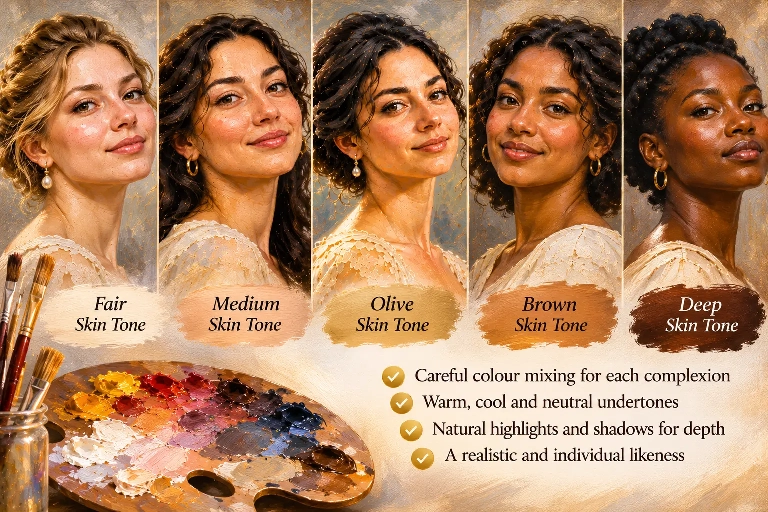
Artists carefully consider individual facial features, expressions, skin tones, body proportions and posture. Consistent lighting, perspective and positioning help create a unified painting while preserving each person's identity.

What canvas size is suitable for an oil portrait featuring multiple people?

The canvas size depends on the number of subjects, their poses and the amount of background detail. Larger family groups generally require more space to ensure that faces remain clearly visible and the composition feels balanced.

Can't Find What You Are Looking For

Contact Us

Sign up to receive the latest news from GFM Painting via email, including exclusive offers and updates...

PORTRAIT & REPRODUCTION
| | | |
PORTRAIT & REPRODUCTION
Show prices in

GFM Designer Ltd
Maultway Court
67-69 Ruxley Lane
Epsom, Surrey
KT19 0JG. UK
E-MAIL : info@gfmpainting.co.uk
PHONE : +44 (0) 203 592 3482
MOBILE : +44(0) 7834 393 396

  • Copyright GFM Designer 2026
  • Company Registration : 07286936
| | | |
GFM Painting top
GFM Painting