Your favourites are only temporarily saved. To find them back, create your account on GFM Painting!
Already have account ?

No gift cards in your cart.
November 18, 2026


Commissioning this type of portrait requires thoughtful planning. The choice of photographs, facial likenesses, relative heights, positioning, clothing, background and painting style all contribute to the final composition. This guide explains how to plan and commission a multi-generation portrait, from gathering family photographs to choosing the right painting medium and preparing the finished artwork for display.
To commission a multi-generation portrait, begin by deciding which family members you want to include and gathering clear photographs of each person. Consider how the generations should be arranged, whether everyone should appear in the same setting and which clothing or personal details should be represented. You can then discuss the composition, painting style, dimensions and preferred medium with the artist before confirming the commission.
Yes. A multi-generation portrait can be created by combining separate photographs of family members taken at different times. Individual reference photographs can be used to capture each person's facial features, expression and appearance. The artist can then develop a unified composition in which the subjects appear naturally positioned together, even if they were never photographed in the same place.
The best painting style depends on the family's preferences, the number of people and the intended appearance of the artwork. Traditional oil painting is often suitable for detailed, realistic family portraits, while watercolour can offer a softer and more delicate finish. Acrylic is versatile and can be used for both realistic and contemporary interpretations. The chosen style should complement the family photographs and the importance of the occasion.
Families are shaped by relationships between grandparents, parents, children and grandchildren. A multi-generation portrait represents these connections visually, allowing different generations to be brought together in one composition.
It can be especially meaningful when family members live in different countries or are unable to gather for a single photograph.
A multi-generation portrait can include relatives who are no longer living. Using historical photographs, the artist can incorporate their likeness into a composition alongside other family members.
This provides a way to remember parents, grandparents and earlier generations while recognising their place within the family's history.
A carefully commissioned portrait can become an important family possession. Displayed in the family home or passed down through generations, it can serve as a visual reminder of shared relationships and memories.
A multi-generation portrait can be commissioned to celebrate a significant birthday, wedding anniversary, family reunion, retirement or another important milestone.
It can also make a meaningful gift for grandparents or parents, particularly when the composition brings together children and grandchildren who may not often be in the same place.
Planning is particularly important when a portrait includes several family members. Establishing who should appear, how they should be positioned and which photographs should be used will help the artist develop a balanced composition.
Begin by identifying everyone who should appear in the painting. This may include grandparents, parents, children, grandchildren and other close relatives.
Consider whether the portrait should represent three generations, four generations or a wider family group. The number of people will influence the painting dimensions and the amount of space required for each individual.
A three-generation portrait might feature grandparents, their adult children and grandchildren. A four-generation composition may also include great-grandparents or great-grandchildren.
The arrangement should make the relationships between family members clear while maintaining a natural and visually balanced appearance.
Consider whether the portrait should be a formal family arrangement, a relaxed group composition or a more intimate gathering around a seated grandparent.
A traditional composition might place older family members in the centre, with younger generations positioned around them. Alternatively, the family may prefer a more informal arrangement that reflects how they naturally spend time together.
The format determines how much of each person will be visible and how the group will fit within the painting.
Reference photographs are central to the success of a multi-generation portrait. Since the family members may have been photographed separately, the artist needs suitable images to understand each person's appearance.
Ideally, provide at least one clear photograph of each person. The image should show the face clearly, with good lighting and recognisable facial features.
Additional photographs can be useful where the main image does not show the person's hairstyle, clothing or preferred expression clearly.
Different photographs may be suitable for different purposes. One image may show a person's face accurately, while another may provide a better reference for their clothing or posture.
Identify the main photograph for each individual and explain which additional images should be used as supporting references.
Older family photographs can be particularly valuable when including grandparents, great-grandparents or relatives who are no longer living. Even faded or black-and-white images may contain useful information about facial features and appearance.
Where possible, provide a high-resolution scan of the original photograph. If the image is damaged or unclear, other photographs of the same person may help establish additional details.
Family members may be represented by photographs taken years apart. This is often unavoidable when creating a portrait that includes several generations.
Consider the age at which each person should appear. For example, grandparents may be represented as they look today, while a deceased relative may appear at the age shown in an older photograph.
To make the process easier, label each photograph with the person's name and their relationship to the other family members. If several photographs are supplied for one person, indicate which should be used as the main facial reference.
A simple written description of the intended composition can also help the artist understand how the family should be arranged.
Facial likeness is one of the most important considerations in a multi-generation portrait. Every individual should remain recognisable, even when several people are included in the same painting.
Each person's facial proportions, eyes, nose, mouth, jawline and other distinctive features contribute to their identity. These details should be carefully considered rather than making all the faces appear overly similar.
A successful multi-generation portrait should represent the ages of the family members naturally. The appearance of a grandparent, parent and child should reflect their individual ages rather than being artificially altered to create a uniform look.
Expressions help communicate the character of each person and the relationships within the family. A gentle smile, a natural expression or a familiar look can make the finished portrait feel more personal.
When choosing reference photographs, consider whether the expressions reflect how the family remembers each individual.
Photographs taken under different lighting conditions may show variations in skin tones and colours. The artist needs to interpret these differences carefully so that the figures appear naturally represented within the same painting.
Where older black-and-white photographs are used, additional colour photographs or family descriptions may provide helpful information.
Bringing several generations together requires more than placing individual figures next to one another. Their positions, proportions, relative heights and expressions should create a convincing family group.
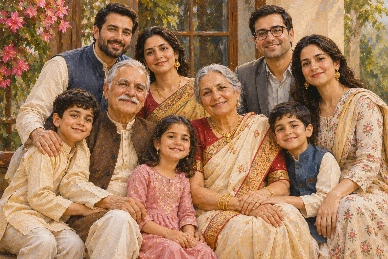
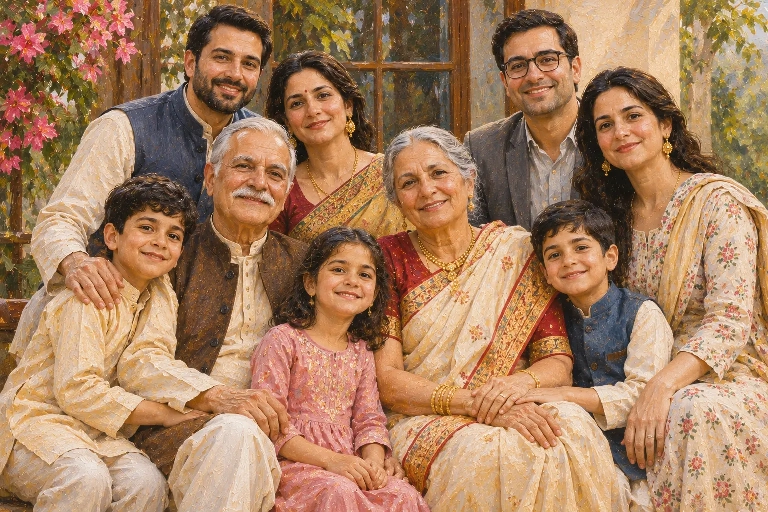
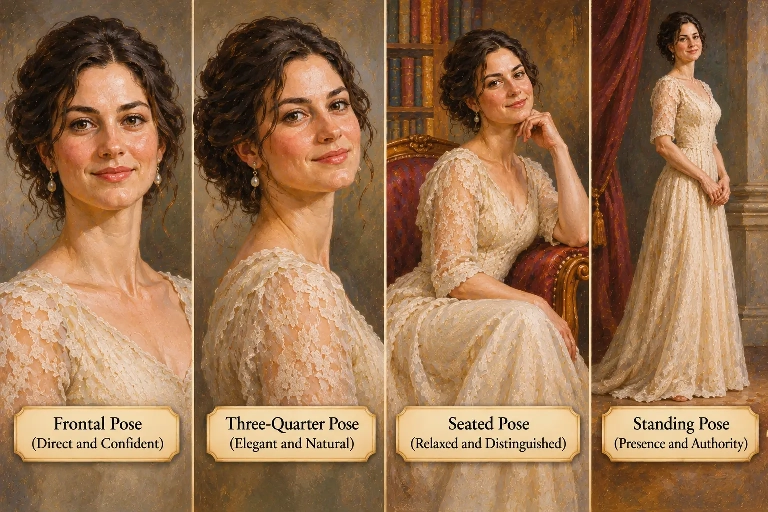
Many multi-generation portraits place grandparents or the oldest generation in a central position. They may be seated, with their children and grandchildren arranged around them.
This can create a strong visual focus while communicating the importance of the older generation within the family.
Parents and children can be positioned beside one another or grouped around grandparents. The arrangement should feel natural and reflect the relationships between the individuals.
Where possible, avoid placing people in rigid rows if a more relaxed arrangement would better represent the family's character.
Differences in height and body proportions should be considered when combining photographs taken separately. The artist must account for camera angles, perspective and the distances between the original subjects.
Children should appear in realistic proportions relative to adults, and seated and standing figures should be arranged in a way that feels natural.
Small details such as a hand resting on a shoulder, a grandparent holding a grandchild's hand or family members sitting close together can help create a sense of connection.
These interactions should be considered as part of the overall composition rather than added without reference to the subjects' natural proportions and poses.
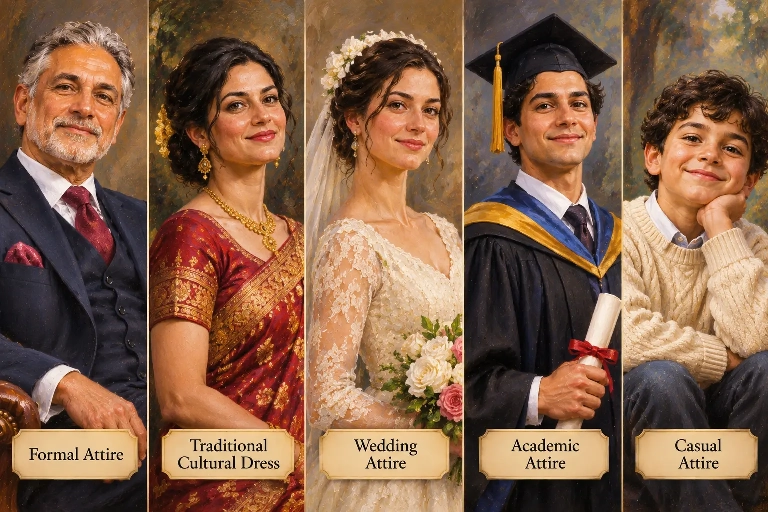
Clothing contributes to the visual character of a multi-generation portrait. It may reflect the family's preferences, cultural background, personal style or the occasion for which the portrait is being commissioned.
Some families prefer coordinated clothing, using complementary colours to create a harmonious composition. Others prefer each person to wear clothing that reflects their individual personality.
Both approaches can work well. The important consideration is how the colours and patterns appear together within the painting.
Traditional clothing can add personal and cultural significance to a family portrait. Sarees, suits, ceremonial garments, jewellery and other distinctive items may be included where they are important to the family.
Clear photographs of the garments and accessories can help the artist represent their colours, patterns and details accurately.
Glasses, watches, jewellery, headwear and other accessories may contribute to an individual's recognisable appearance. If these details are important, provide suitable reference photographs.
Clothing should complement the overall composition without making the individuals appear artificially uniform. The portrait can retain each person's individual style while using a considered colour balance across the group.
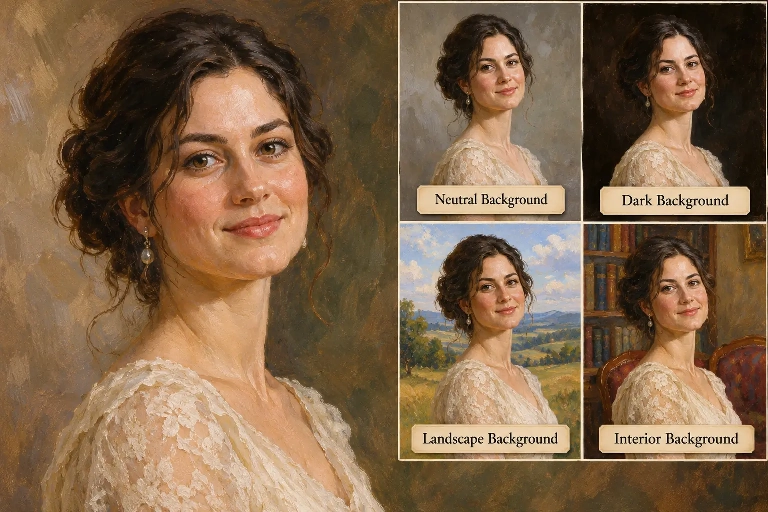
The background can provide context and atmosphere for a multi-generation portrait. It may be a simple neutral setting, a family home, a garden or a location that holds particular meaning for the family.
A simple painted background can create a timeless appearance and keep attention on the family members. This may be suitable when the main priority is facial likeness and the relationships between generations.
A familiar family home or garden can make the portrait feel more personal. It may be particularly meaningful if the location has been part of the family's history for many years.
A landscape, ancestral home or special location may be included where it has personal significance. Reference photographs can help the artist understand the setting and identify important details.
The background should support the family group rather than compete with it. Too many decorative elements can distract from the people, particularly when the painting already includes several subjects.
One of the main advantages of commissioning a multi-generation portrait is the ability to bring together family members who were never photographed together. Separate images can be used to develop a single composition that represents the family as a whole.
Photographs may have been taken in different decades, locations and circumstances. The artist can use these images as references for the individual subjects while developing a unified setting and composition.
Historical photographs can be used to represent family members who have passed away. This can be particularly important when creating a portrait that brings together several generations of a family.
Where possible, provide more than one photograph of the relative so that the artist can better understand their appearance.
Separate photographs may show people from different camera angles and distances. These differences need to be considered so that the individuals appear to occupy the same space naturally.
The final arrangement should look like a genuine family portrait rather than a collection of unrelated figures. Consistent lighting, appropriate proportions and natural positioning help create visual unity.
The choice of painting medium influences the appearance, texture and character of a multi-generation portrait. Oil painting, watercolour and acrylic each offer different artistic possibilities.
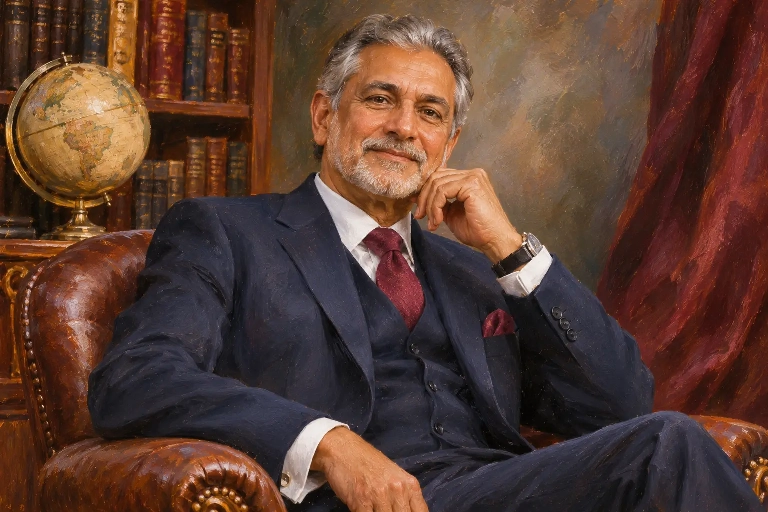
Oil painting is a popular choice for detailed family portraits. It allows the artist to develop depth, subtle tonal variations and carefully blended colours.
Oil paint can be particularly effective when the composition includes several faces, detailed clothing and a carefully developed background. It is often suitable for traditional family portraits intended to become long-term heirlooms.
Watercolour offers a softer and more delicate appearance. Its transparent washes and subtle colour transitions can create an elegant interpretation of a family group.
Traditional watercolour is generally painted on specialist watercolour paper. The paper's texture and weight contribute to the appearance and handling of the finished artwork.
Acrylic is a versatile medium that can be used for both realistic and expressive family portraits. It allows the artist to work with strong colours, defined details and varied textures.
It may be suitable for families who prefer a contemporary interpretation rather than a traditional portrait style.
A realistic style places emphasis on accurate facial likeness, proportions and recognisable details. An expressive approach may use visible brushwork, softer backgrounds or a more interpretive treatment of colour.
The best choice depends on the family's preferences, the reference photographs and the intended display of the painting.
The dimensions of a multi-generation portrait should reflect the number of people, the chosen composition and the intended display location. A larger family group generally needs more space than a portrait of two or three people.
Smaller dimensions may be suitable for a composition featuring a limited number of people, particularly when the painting focuses on head-and-shoulders or half-length portraits.
Larger paintings provide more space for individual facial details, clothing, body positions and background elements. They may be particularly suitable for portraits featuring several generations or a full-length composition.
Oil and acrylic paintings are commonly produced on canvas or other suitably prepared surfaces. Watercolour is traditionally painted on specialist watercolour paper, although alternative prepared surfaces may be used depending on the artist's technique.
The surface should be selected according to the chosen medium, the composition and the desired presentation.
Before confirming the dimensions, consider where the finished portrait will be displayed. Measure the available wall space and think about viewing distance, room proportions and surrounding furniture.
The cost of a multi-generation portrait depends on several factors, including the dimensions, number of people, complexity of the composition, painting medium and level of detail.
Each additional person requires attention to facial likeness, proportions, clothing and positioning. A portrait featuring several generations will generally involve more work than a single-person portrait.
Larger paintings generally require more materials and working time. They also provide additional space for detailed clothing, body positions and backgrounds.
A formal group arrangement may require less compositional development than a scene featuring several people interacting in a detailed family setting.
Detailed facial features, patterned clothing, jewellery, furniture and architectural backgrounds can increase the amount of work involved.
Oil, watercolour and acrylic involve different materials and techniques. The time required depends on the chosen medium and the complexity of the artwork.
When requesting a quotation, provide the number of family members, reference photographs, preferred dimensions and painting medium. Include a description of the intended arrangement, clothing and background.
Explaining the purpose of the portrait and the importance of any historical or personal details can also help establish the scope of the commission.
Commissioning a multi-generation portrait involves several stages. Preparing the reference photographs and discussing the composition carefully can help establish a shared understanding of the intended artwork.
Begin by explaining the family members you would like to include and the purpose of the painting. Describe the number of generations, preferred composition, approximate dimensions and intended display location.
Provide the best available photographs of each person. Label the images clearly and identify the main reference photograph for every family member.
Explain how you would like the family to be arranged. Consider who should be seated, who should stand and how the generations should relate to one another within the painting.
Discuss the preferred medium, artistic style, dimensions and level of detail. The quotation should reflect the agreed scope of the commission.
The artist develops the composition using the agreed reference photographs. Particular attention is given to the likeness of each family member, the relative proportions and the overall balance of the group.
Once the painting is complete, consideration can be given to framing and presentation. The final artwork should be prepared in a way that suits its intended display and long-term care.
The time required to complete a multi-generation portrait depends on the number of people, painting dimensions, complexity of the composition and chosen medium.
A painting featuring several generations may require considerable preparation because the artist must work with separate photographs, establish the arrangement and maintain accurate proportions across the group. Detailed clothing and backgrounds can add to the time involved.
Oil paintings may require additional time because of the techniques and drying stages involved. Watercolour and acrylic have different working processes, and the time required depends on the artist's approach.
If the portrait is intended for a family reunion, milestone birthday, anniversary or other special occasion, it is sensible to begin the enquiry well in advance. This allows sufficient time to gather photographs and plan the composition carefully.
The finished portrait may become a central feature in the family home. Choosing the right frame and display location helps present the artwork while protecting it over time.
A traditional frame may complement a formal oil painting, while a simpler frame may suit a contemporary family portrait. Consider the colours in the artwork and the interior where it will be displayed.
Living rooms, hallways, dining rooms and family spaces can all be suitable locations. Choose a position where the painting can be appreciated while avoiding prolonged exposure to direct sunlight or excessive moisture.
A large multi-generation portrait can become a focal point within the home. Allow enough space around the artwork so that the family group can be viewed clearly and the details appreciated.
Protect the painting from dust, moisture, direct sunlight and physical damage. Avoid placing it close to radiators, fireplaces or areas with significant temperature fluctuations.
Different painting mediums have different care requirements. Follow the artist's guidance for the particular surface and medium used.
Because a multi-generation portrait involves several people and often carries considerable emotional significance, careful preparation is important.
A single photograph may not show every person's facial features clearly. Provide additional images where necessary, particularly when working with older or damaged family photographs.
When supplying photographs of several relatives, label each image and explain the relationship between the individuals. This helps avoid confusion when developing the composition.
Family members may be represented at different stages of life. Make it clear which age and appearance should be used for each person, particularly when combining historical and recent photographs.
People photographed separately may appear at different scales. The final composition needs to account for relative heights, body proportions and camera perspective so that the group looks natural.
A detailed setting can add meaning, but too many objects and decorative features may distract from the family members. Prioritise the details that matter most.
A large family group needs sufficient space for each person's face and clothing to remain recognisable. Consider the number of subjects before deciding on the dimensions.
Gathering photographs and planning a composition involving several generations can take time. Begin early, especially if the painting is intended for an important family occasion.
A multi-generation portrait is more than a family painting. It is a celebration of the relationships, memories and shared experiences that connect grandparents, parents, children and future generations.
By bringing together photographs taken at different times, a hand-painted portrait can create a single composition that may never have been possible through conventional family photography. It can also preserve the likeness of relatives who are no longer living, allowing their place within the family story to remain visible.
Choosing suitable reference photographs, planning the arrangement, preserving individual facial likenesses and selecting the right artistic style are all essential parts of the commissioning process. The most successful portraits balance accurate representation with a natural composition that reflects the family's personality and relationships.
Whether commissioned for a family reunion, milestone birthday, anniversary or simply to celebrate the people who matter most, a multi-generation portrait can become a treasured family heirloom. It is a lasting reminder of the connections that bring generations together.
At GFM Painting, we create hand-painted portraits from photographs, helping families transform meaningful images into individual works of art.
Whether you are planning a portrait of three or four generations, bringing together relatives from separate photographs or remembering loved ones who are no longer with you, the reference images and intended composition provide the starting point for a personalised commission.
To discuss a multi-generation portrait, visit GFM Painting and share your family photographs and ideas. Consider the number of people, preferred painting medium, dimensions and the arrangement you would like the finished artwork to represent.
Visit GFM Painting to explore hand-painted family portrait commissions.
Websites Built to Grow Your Business
Professional Web Design • Development • SEO • Digital Marketing
Read More
Discover a different perspective on wealth, stewardship, purpose and leadership.
Read MoreEvery generation contributes to the story, memories and traditions of a family.
A hand-painted multi-generation portrait brings those connections together in one meaningful composition.
From grandparents and parents to children and grandchildren, each individual has a place in the family story.
Even when photographs were taken years apart, a personalised painting can bring loved ones together in one lasting image.
Celebrate the people who connect your generations through the timeless art of portraiture.
Frequently Asked Questions
Yes. A multi-generation portrait can include loved ones who are no longer living. Historical family photographs can be used to recreate their likeness and bring them together with other generations in one composition.
A portrait can include two, three, four or more generations, depending on the available photographs, desired composition and painting dimensions. Larger family groups may require a bigger canvas to preserve individual details.
Yes. Photographs taken at different times can be combined to create a unified family composition. The artist considers each person's age, facial features, proportions and position to make the arrangement look natural.
Yes. Family members can be represented in different outfits, including traditional clothing, formal attire or everyday clothing. Reference photographs help the artist capture the colours, patterns and individual details.
GFM Designer Ltd
Maultway Court
67-69 Ruxley Lane
Epsom, Surrey
KT19 0JG. UK
E-MAIL : info@gfmpainting.co.uk
PHONE : +44 (0) 203 592 3482
MOBILE : +44(0) 7834 393 396