Your favourites are only temporarily saved. To find them back, create your account on GFM Painting!
Already have account ?

No gift cards in your cart.
November 13, 2026


Every successful painting begins with more than a subject. Before the first layer of paint is applied, an artist must consider how the different elements will be arranged within the picture. The position of the main subject, the relationship between shapes, the distribution of colour and the use of empty space all influence how the finished artwork will be experienced.
Composition is the process of organising these elements into a visual structure. It helps establish a focal point, creates balance and directs the viewer's attention through the painting. Whether an artist is creating a portrait, landscape, still life or figurative scene, compositional decisions play an essential role in shaping the final result.
Composition in art is the arrangement of visual elements within an artwork. It includes the placement of subjects, shapes, lines, colours, light and negative space to create visual balance, establish a focal point and communicate an intended atmosphere or meaning.
Artists develop compositions by studying their subject, producing preliminary sketches, testing different arrangements and considering visual balance, proportions, focal points, colour and tonal relationships before transferring the chosen design onto the painting surface.
Composition determines how viewers experience an artwork. It creates structure, guides attention, establishes relationships between subjects and surroundings, and helps communicate the artist's intended message, mood and visual expression.
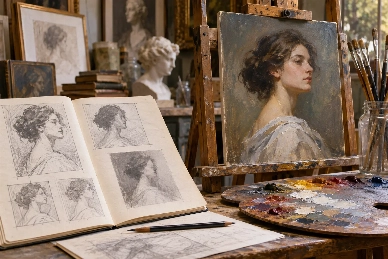
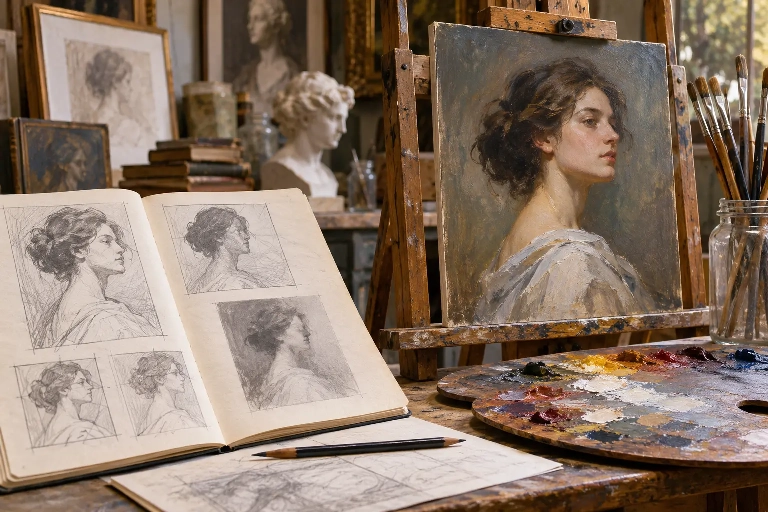
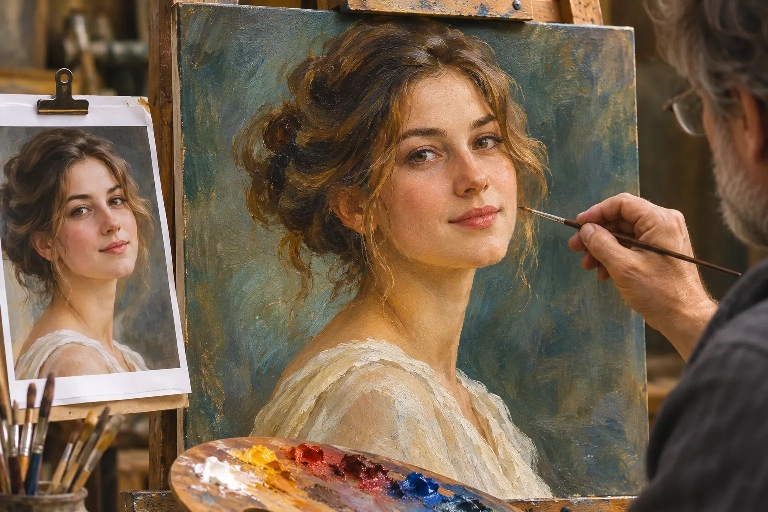
Inside an artist's studio, composition often develops through a process of exploration rather than a single decision. An initial idea may lead to several sketches, alternative arrangements and adjustments before the artist discovers the most effective visual structure.
A subject can be technically well painted but still feel unbalanced if its elements are poorly arranged. Equally, a relatively simple subject can become visually compelling when the artist carefully considers proportion, space, direction and the relationship between light and shadow.
Developing a composition is therefore both an analytical and creative activity. Artists use established principles of design while making individual decisions that reflect their interpretation of the subject.
The first stage of developing a composition is understanding what the painting is intended to communicate. An artist considers the subject, its visual characteristics and the overall impression they want the viewer to experience.
For a portrait, this may involve deciding whether the person's face should dominate the composition or whether the surrounding environment should contribute to the story. In a landscape, the artist may consider the relationship between the foreground, middle distance and horizon. A still-life painting may focus on the arrangement of objects, their shapes and the spaces between them.
Reference photographs, observation from life and preliminary studies can help artists understand the subject more thoroughly. However, a reference does not have to dictate the final arrangement. Artists may reposition objects, simplify backgrounds, adjust proportions or remove distracting details to strengthen the overall composition.
At this stage, the artist is identifying the most important visual elements and deciding how they should work together.
Preliminary sketches allow artists to investigate different arrangements before beginning the final painting. These studies are often quick and relatively simple, concentrating on the overall structure rather than fine details.
An artist might produce several thumbnail sketches, each exploring a different position for the main subject. One arrangement may place the subject centrally, while another may position it towards one side, leaving more open space elsewhere in the picture.
These alternatives help the artist assess how changes in placement affect visual balance and direction. A composition that initially appears attractive may become less effective when viewed as a small sketch or when its main shapes are simplified.
Artists may also create preliminary tonal studies to explore the distribution of light and dark areas. These studies reveal whether the composition has sufficient contrast and whether the viewer's attention is likely to move towards the intended focal point.
Planning in this way provides flexibility. It allows the artist to experiment and make important decisions before investing considerable time in the finished work.
Visual balance describes how the elements of a painting are distributed across the picture plane. It does not necessarily mean that both sides of a composition must be identical. Instead, it concerns how visual weight is organised so that the overall arrangement feels intentional and coherent.
Symmetrical compositions arrange elements in a similar way on either side of a central axis. This can create a sense of order, stability and formality. It is often effective in architectural subjects, formal portraits and carefully arranged still-life paintings.
Asymmetrical compositions use different shapes, sizes, colours or positions to create visual equilibrium without mirroring the two sides. A large subject on one side may be balanced by several smaller elements or an area of strong colour on the other.
Lines influence how viewers move through a painting. Horizontal lines can suggest calmness and stability, while vertical lines may create a sense of height or strength. Diagonal lines often introduce movement, energy or tension.
Artists can use the direction of figures, architectural features, landscape forms and other visual elements to guide the viewer towards important areas of the composition.
Negative space is the area around and between the main subjects. It is not simply unused space. Its shape, size and relationship with the positive forms can be just as important as the objects themselves.
Carefully considered negative space can prevent a painting from feeling crowded, improve the separation between subjects and create a stronger sense of proportion. In portraiture, for example, the space around a person's head can influence how the figure sits within the overall picture.
The focal point is the area that attracts the viewer's attention most strongly. It may be a person's face, an important object, a dramatic section of the landscape or a particular interaction between figures.
Artists establish focal points through several visual devices:
Not every painting requires one dominant focal point. Some compositions encourage the viewer to explore several areas of interest, creating a more complex visual journey. The important consideration is that the distribution of attention should support the purpose of the artwork.
Colour and light contribute significantly to the structure of a composition. They influence visual balance, depth, atmosphere and the relationship between the main subject and its surroundings.
Before selecting individual colours, artists often consider the overall tonal arrangement. Tonal value refers to how light or dark a colour appears. A painting with a clear distribution of light, middle and dark values can remain visually understandable even when viewed from a distance or in a simplified monochrome study.
Light areas can attract attention, while darker passages may provide contrast, establish depth or help frame the subject. The relationship between these areas can guide the viewer's eye and reinforce the focal point.
Colour relationships also affect the character of a composition. Warm colours may appear visually prominent, while cooler colours can create distance or atmosphere. Complementary colours can introduce contrast, while related colours may create harmony and continuity.
Artists must consider how colours interact across the entire picture rather than treating each object as an isolated element. A colour used in one area may be repeated elsewhere to create visual unity and connect different parts of the composition.
Once the artist has selected a composition, the design must be transferred to the final painting surface. This stage involves establishing the main proportions and ensuring that the arrangement works within the chosen dimensions.
Artists may use a light drawing, a preparatory underpainting or a grid to transfer important shapes and positions. The method depends on the subject, the artist's working process and the level of accuracy required.
The dimensions of the canvas also influence compositional decisions. A wide horizontal surface may suit a landscape or a group of figures, while a vertical format can be effective for portraits and full-length subjects. A square format may create a more contained and balanced arrangement.
Changing the dimensions can require adjustments to the original design. A composition developed for a horizontal reference image may not automatically work on a tall canvas. The artist may need to extend the background, reposition the subject or reconsider the amount of space around the main elements.
Throughout the painting process, the artist continues to assess the relationship between the drawing, the painted forms and the overall arrangement. The initial composition provides a framework, but it does not prevent further creative development.
Composition is not always finalised before painting begins. As the artwork develops, artists may recognise opportunities to improve the arrangement or discover that certain elements are competing for attention.
Reviewing the painting from a distance can reveal problems that are less obvious when working closely. An artist may also view the work in a mirror or take a photograph to gain a different perspective. These methods can help identify awkward tangencies, uneven spacing, distracting details or an unclear focal point.
Common adjustments include:
These refinements are part of the artist's decision-making process. A successful composition is not simply one that follows established rules, but one in which the visual elements work together to support the character and intention of the painting.
Developing a composition is one of the most important stages in creating an original painting. It brings together the subject, visual balance, focal points, shapes, lines, colour, light and negative space into a considered arrangement.
Through sketches, observation and experimentation, artists discover how different elements can work together to create a coherent and engaging image. These decisions continue throughout the painting process, allowing the composition to evolve as the artwork develops.
Ultimately, composition gives a painting its visual structure. It helps the artist communicate an idea, establish an atmosphere and guide the viewer through the finished work.
Websites Built to Grow Your Business
Professional Web Design • Development • SEO • Digital Marketing
Read More
Discover a different perspective on wealth, stewardship, purpose and leadership.
Read MoreEvery painting begins with an idea, but transforming that idea into a compelling work of art requires careful thought and creative decisions.
Inside the artist's studio, composition takes shape through observation, experimentation and the exploration of different visual arrangements.
From preliminary sketches to the positioning of subjects, every element contributes to the balance, movement and atmosphere of the finished painting.
Discover how artists use colour, light, perspective and negative space to guide the viewer's eye and bring their creative vision to life.
Frequently Asked Questions
The main principles include balance, proportion, contrast, emphasis, rhythm, movement and unity. Artists use these principles to organise visual elements, establish focal points and create a harmonious arrangement.
The rule of thirds is a compositional guideline that divides an image into nine equal sections using two horizontal and two vertical lines. Placing important subjects near the intersections or along these lines can create a more balanced and engaging composition. However, artists do not have to follow this rule in every painting.
Artists consider the subject's importance, the intended message and how they want viewers to experience the painting. Contrast, colour, lighting, detail and positioning can all help establish the focal point and draw attention towards it.
Yes. Artists frequently adjust compositions as their work develops. They may reposition elements, modify backgrounds, strengthen contrasts or introduce changes to improve visual balance and clarify the main subject.
GFM Designer Ltd
Maultway Court
67-69 Ruxley Lane
Epsom, Surrey
KT19 0JG. UK
E-MAIL : info@gfmpainting.co.uk
PHONE : +44 (0) 203 592 3482
MOBILE : +44(0) 7834 393 396