Your favourites are only temporarily saved. To find them back, create your account on GFM Painting!
Already have account ?

No gift cards in your cart.
November 13, 2026


Claude Monet transformed the way artists observed and represented the natural world. Rather than treating colour as a fixed description of objects, he explored how it changed with sunlight, weather, atmosphere and the passing of time. Through vibrant palettes, broken brushstrokes and repeated studies of the same subject, Monet developed an approach to painting that made light and colour central to artistic expression.
From the shimmering reflections of the Seine to the changing appearance of Rouen Cathedral and the tranquil water-lily pond at Giverny, Monet continually explored the relationship between colour and perception. His paintings capture not simply what a landscape looked like, but how it appeared at a particular moment.
Monet used colour to capture the changing effects of natural light and atmosphere. He placed visible brushstrokes and varied tones alongside one another to represent reflections, shadows, weather and the temporary appearance of a scene.
Monet revisited subjects such as haystacks, poplar trees and Rouen Cathedral to investigate how their appearance changed throughout the day and across different weather conditions. By painting the same subject repeatedly, he could explore variations in light, colour and atmosphere.
Traditional academic painting often prioritised clearly defined forms, controlled modelling and consistent local colours. Monet increasingly used broken brushwork, brighter colour relationships and changing tonal effects to capture the immediate visual experience of a subject.
Claude Monet (1840–1926) was one of the leading figures of Impressionism, an artistic movement that challenged established approaches to painting during the nineteenth century. His work placed particular importance on observing nature directly and recording the changing effects of light.
For Monet, the colour of an object was never entirely fixed. A building could appear pink in the morning, golden in the afternoon and blue-grey under an overcast sky. Water could reflect the colours of the surrounding landscape, while shadows could contain subtle variations rather than simply appearing black.
This interest in changing appearances became one of the defining characteristics of his artistic vision. Monet explored how colour could communicate atmosphere, movement and the passage of time.
His approach developed throughout a long career, from his early landscapes in Normandy and the Impressionist paintings of the 1870s to the ambitious series paintings and monumental Water Lilies of his later years.
Monet was born in Paris in 1840 and grew up in Le Havre, on the Normandy coast. The coastal environment provided an early introduction to the changing appearance of natural light, sea, sky and landscape.
An important influence during his youth was the painter Eugène Boudin, who encouraged Monet to paint outdoors. This practice, known as en plein air, allowed artists to observe their subjects directly rather than relying entirely on studio sketches and imagination.
Another important influence was Johan Jongkind, whose landscapes helped Monet develop his understanding of atmosphere and natural light.
Painting outdoors encouraged Monet to pay close attention to:
After moving to Paris, Monet studied at the studio of Charles Gleyre, where he met artists including Pierre-Auguste Renoir, Alfred Sisley and Frédéric Bazille. These friendships contributed to the development of the group that would become associated with Impressionism.
During the 1860s, Monet increasingly moved away from the highly controlled approach associated with academic painting. He became interested in capturing modern life and the natural environment through direct observation and more spontaneous brushwork.
His paintings began to place greater emphasis on the overall visual impression of a scene rather than the precise definition of every object.
This developing approach established the foundations for his distinctive use of colour and light.
The first Impressionist exhibition took place in Paris in 1874. Monet exhibited a painting titled Impression, Sunrise (1872), depicting the harbour at Le Havre.
The painting's loose brushwork, atmospheric setting and striking relationship between the orange sun and blue-grey surroundings challenged conventional expectations of finished landscape painting. Its title became closely associated with the Impressionist movement.
Monet's approach was based on the belief that painting could communicate the changing appearance of a subject at a particular moment.
Instead of outlining every object precisely, he often used separate touches and patches of colour to suggest the effects of light.
His techniques included:
Water became one of Monet's most important subjects because its appearance changed constantly.
In works such as La Grenouillère (1869), Monet explored the movement of water and the shifting reflections of people, boats and surrounding structures.
Rather than describing every reflection in detail, he used loose brushwork and colour variations to suggest the movement of the water's surface.
This approach helped establish his interest in painting the effects of light rather than simply recording the physical appearance of objects.
Monet's use of colour was not limited to reproducing the natural colours of his subjects. He explored how colours interacted and how their relationships could create atmosphere and visual impact.
His paintings frequently combine warm and cool tones, complementary colours and subtle variations in brightness.
Warm colours, including yellows, oranges and reds, often appear alongside cooler blues, greens and violets.
These relationships help create visual contrast and communicate the changing conditions of natural light.
For example:
One of Monet's important contributions was his treatment of shadows as areas containing colour rather than simply darkness.
Traditional painting frequently used dark tones to establish shadows and volume. Monet explored the subtle colours created by reflected light and atmospheric conditions.
As a result, shadows in his paintings can contain blues, purples, greens and other colours influenced by their surroundings.
Japanese woodblock prints also influenced Monet's artistic development. Their compositions, simplified forms, unusual viewpoints and decorative arrangements offered alternatives to established European conventions.
This influence can be considered alongside Monet's broader interest in composition, colour and the visual organisation of the natural world.
Together, these experiments helped him develop a distinctive artistic language.
One of Monet's most significant contributions to modern painting was his exploration of repeated subjects, often described as series paintings.
Instead of choosing a different subject for every painting, he returned to the same location or object under changing conditions.
His subjects included haystacks, poplar trees and the façade of Rouen Cathedral.
In the Haystacks series, Monet explored how the same agricultural structures appeared under different lighting conditions and at different times of day.
The haystacks became a way to investigate:
The subject remained recognisable, but the colours and overall atmosphere changed from painting to painting.
Monet's Poplars series explored the relationship between trees, water, reflections and the surrounding environment.
The repeated vertical forms of the trees created a strong compositional structure, while changes in light and colour transformed the atmosphere of each painting.
Between 1892 and 1894, Monet created more than thirty paintings of Rouen Cathedral, concentrating particularly on its western façade.
The cathedral provided a relatively constant subject through which he could examine the changing effects of light.
Depending on the conditions, the stone façade could appear in shades of pink, gold, blue, grey and violet.
Monet worked on multiple canvases, moving between them as the light changed. The resulting paintings demonstrate how colour can transform the appearance of the same architectural structure.
These series established colour and atmosphere as subjects in their own right, rather than merely supporting the representation of an object.
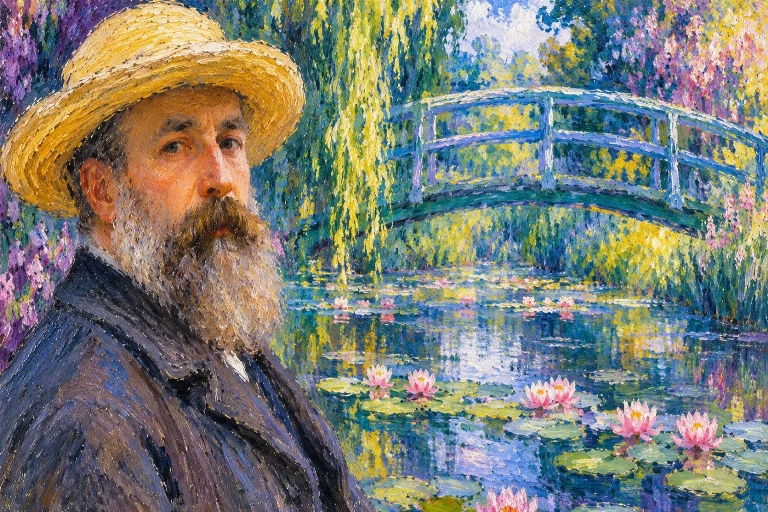
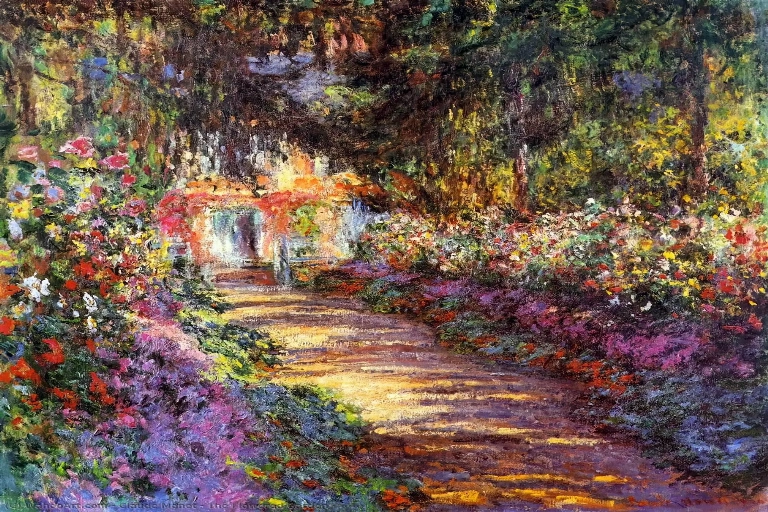
In 1883, Monet settled at Giverny in Normandy. He later developed an extensive garden there, including the famous water-lily pond that became one of the central subjects of his later career.
The garden provided an environment in which he could explore the relationship between water, reflections, flowers, foliage and changing light.
The pond offered an almost endless variety of visual possibilities.
Monet observed how the surface of the water reflected the sky, surrounding trees and vegetation. These reflections changed with the weather and the time of day.
His paintings explored:
In the later Water Lilies paintings, Monet increasingly moved away from conventional landscape composition.
The horizon often disappears, and the viewer is drawn into a continuous arrangement of water, reflections and vegetation.
Broad brushstrokes, layered colours and complex surface textures become more important than clearly defined objects.
These paintings demonstrate how Monet's interest in colour and perception developed into a more expansive and experimental visual language.
His monumental Water Lilies compositions, now displayed in specially designed galleries at the Musée de l'Orangerie in Paris, remain among the most celebrated achievements of his career.
Monet's artistic approach had a lasting influence on the development of modern painting. His exploration of colour, perception and atmospheric effects helped expand the possibilities of landscape painting.
Several techniques are particularly associated with Monet's work:
Monet's work helped establish colour and visual perception as central concerns in modern art.
His later paintings, particularly the Water Lilies series, influenced artists interested in expressive colour, abstraction and the relationship between painting and the viewer's experience.
Although Monet remained associated with Impressionism throughout his life, his later work increasingly challenged conventional distinctions between landscape representation and abstraction.
Monet died in 1926 at Giverny, aged 86. His legacy extends far beyond his contribution to Impressionism.
He demonstrated that a familiar subject could be transformed through changes in colour, light and atmosphere. His paintings continue to encourage artists to observe nature carefully and explore how colour can communicate more than the physical appearance of a scene.
Claude Monet transformed colour from a supporting element of landscape painting into one of its most powerful forms of expression.
Through outdoor observation, experimental brushwork and repeated studies of the same subjects, he explored how light and atmosphere continually changed the appearance of the natural world.
From Impression, Sunrise and the Haystacks series to Rouen Cathedral and the monumental Water Lilies, his paintings reveal an extraordinary commitment to observing colour in all its changing forms.
His artistic vision reminds us that the world does not appear in fixed colours. Every moment brings different relationships between light, shadow, atmosphere and perception.
Monet's legacy lies in this way of seeing: an invitation to look beyond the objects themselves and discover the constantly changing beauty of colour.
Websites Built to Grow Your Business
Professional Web Design • Development • SEO • Digital Marketing
Read More
Discover a different perspective on wealth, stewardship, purpose and leadership.
Read MoreClaude Monet transformed the way artists understood colour, turning the natural world into a constantly changing experience of light, atmosphere and artistic expression.
From the shimmering reflections of the Seine to the golden tones of his Haystacks and the changing appearance of Rouen Cathedral, Monet explored how the same subject could look entirely different under changing conditions.
Through expressive brushwork, vibrant colour combinations and remarkable observation, he captured fleeting moments of nature that traditional painting had often overlooked.
His celebrated Water Lilies paintings reveal the extraordinary development of his artistic vision, where reflections, flowers and water become immersive compositions filled with colour, movement and light.
Discover how Monet developed his distinctive approach to colour, helped shape Impressionism and created an artistic legacy that continues to inspire painters and captivate art lovers around the world.
Frequently Asked Questions
One of Monet's early important successes was Women in the Garden (1866–1867), which demonstrated his interest in painting figures outdoors and capturing natural light. Although it initially faced rejection from the Paris Salon, it helped establish the direction of his developing artistic style.
Impression, Sunrise (1872) depicts the harbour at Le Havre. Its loose brushwork and atmospheric treatment of light helped inspire the name of the Impressionist movement after the painting was exhibited in 1874.
Monet developed his garden at Giverny as both a personal retreat and a source of artistic inspiration. He carefully cultivated flowers, trees and a water-lily pond, creating subjects that allowed him to explore reflections, changing light and colour throughout the seasons.
Painting outdoors was particularly important during Monet's earlier and middle periods. However, he increasingly worked with multiple canvases and returned to the studio to develop his paintings, especially when creating his extensive series and later Water Lilies compositions.
GFM Designer Ltd
Maultway Court
67-69 Ruxley Lane
Epsom, Surrey
KT19 0JG. UK
E-MAIL : info@gfmpainting.co.uk
PHONE : +44 (0) 203 592 3482
MOBILE : +44(0) 7834 393 396