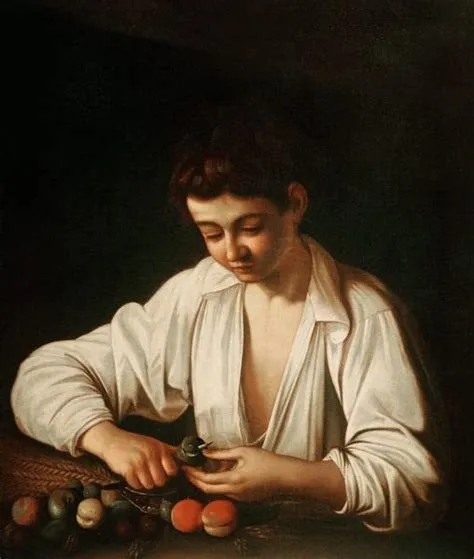
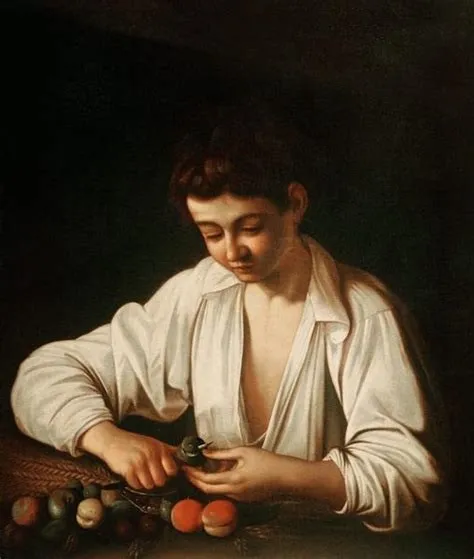
Caravaggio’s "Boy Peeling Fruit" exemplifies his mastery over oil on canvas, showcasing intricate details and lifelike textures. The delicate rendering of the fruit and the boy’s contemplative expression reveal the painter’s skillful technique. As with "Saint Jerome Writing" and "The Taking of Christ", Caravaggio’s brushwork and dramatic use of light set his works apart in the Baroque movement. Collectors and art lovers alike appreciate the depth and realism found in this oil on canvas masterpiece.
Every element in "Boy Peeling Fruit" tells a silent story, inviting viewers to ponder its deeper meaning. Caravaggio often imbued his hand-painted oil paintings with symbolism, and this work is no exception. The act of peeling fruit may represent innocence or the fleeting nature of youth, themes echoed in other Baroque gems like "Doubting Thomas" and "Judith Beheading Holofernes". Such narrative richness makes this fine art painting for sale an intriguing addition to any collection.
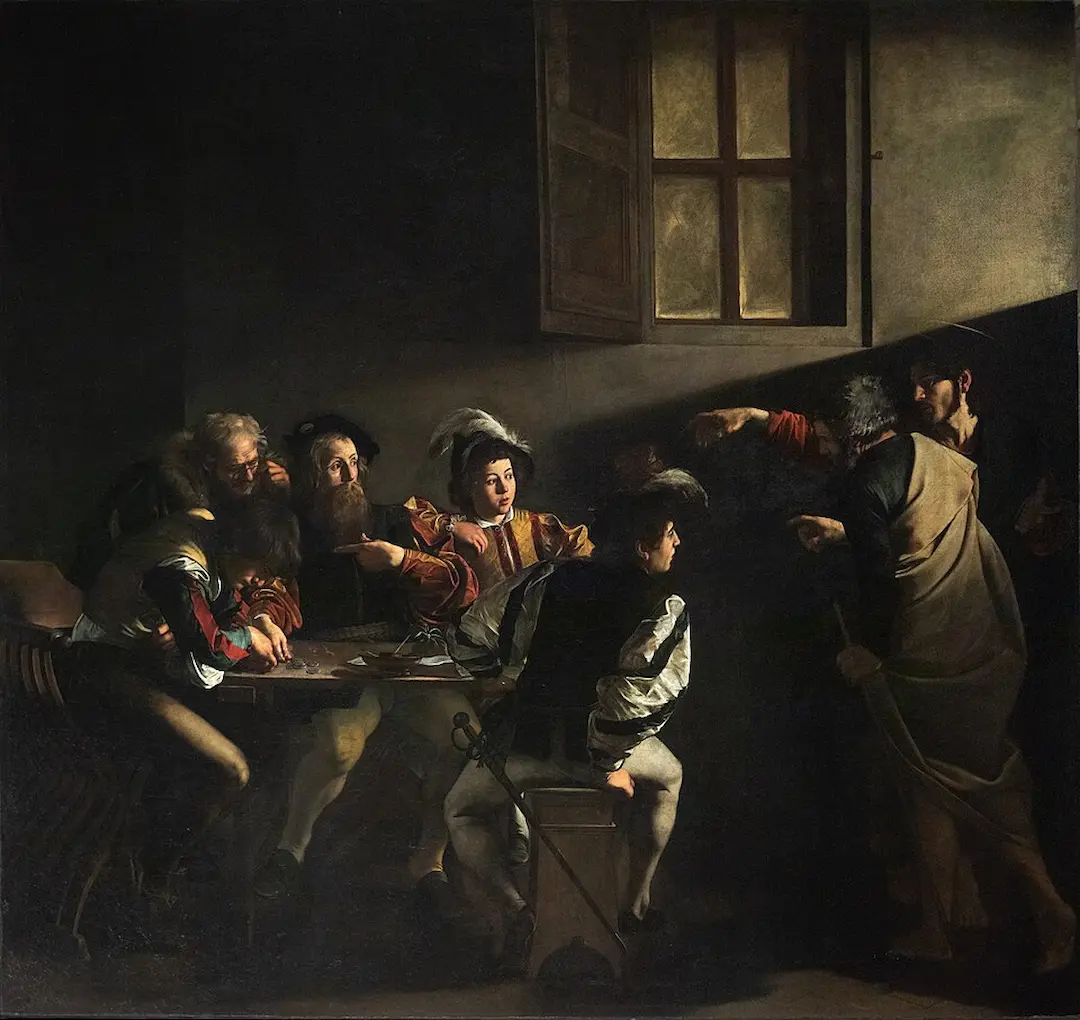
Owning "Boy Peeling Fruit" by Caravaggio is akin to possessing a piece of Baroque history. This fine art painting for sale appeals to discerning collectors seeking authenticity and timeless beauty. The painting’s connection to other renowned works—such as "The Calling of Saint Matthew" and "Saint Jerome Writing"—enhances its allure. Whether displayed alongside other Caravaggio masterpieces or as a standalone oil on canvas, it remains a testament to artistic brilliance and enduring value.
When Art Meets History
"Boy Peeling Fruit" by Caravaggio stands as a remarkable example of Baroque artistry, capturing a moment suspended in time. Painted in the late 16th century, this hand-painted oil painting is often discussed alongside works like "The Angel and Hagar" and "Self-Portrait." As a cornerstone of the Baroque movement, Caravaggio’s painting bridges the gap between everyday life and historical narrative, giving viewers a glimpse into both the artist’s world and the evolution of fine art.
Techniques That Speak
Caravaggio’s mastery of oil on canvas shines in "Boy Peeling Fruit," where dramatic light and shadow create lifelike depth. This Baroque masterpiece employs chiaroscuro, a technique that defines form through contrasting tones. Similar methods can be seen in related paintings such as "Holy Family" and "Mercury and Battus." The careful attention to texture and realism marks this work as a pivotal moment in art history, showcasing the artist’s innovative approach to oil on canvas.
Emotions on Display
In "Boy Peeling Fruit," Caravaggio infuses subtle emotion into an everyday scene, a hallmark of Baroque fine art painting for sale today. The boy’s focused expression and gentle handling of the fruit evoke an intimate, almost vulnerable atmosphere. This emotional depth is echoed in Caravaggio’s other works like "Portrait of Charles II." The painting’s realism invites viewers to empathize with the subject, making it a timeless example of the artist’s ability to portray human feeling.
Coveted by Collectors
"Boy Peeling Fruit" holds a special place among collectors of Baroque art, sought after for its historical significance and exquisite technique. As a hand-painted oil painting, it represents the pinnacle of Caravaggio’s early career and is often compared to "The Angel and Hagar" and "Holy Family." Today, such works are highly prized, with fine art painting for sale from this era commanding attention in galleries and auctions around the world.
Related Baroque Hand-Painted Oil Paintings by Other Artists
Other Famous Baroque Artists:
Frequently Asked Questions About Boy Peeling Fruit
Who is the artist of "Boy Peeling Fruit"?
The painting "Boy Peeling Fruit" was created by the renowned Italian Baroque artist Caravaggio, known for his dramatic use of light and shadow.
What is the historical context of "Boy Peeling Fruit"?
What artistic techniques are evident in this painting?
Caravaggio employs chiaroscuro, a technique that contrasts light and dark to create depth and volume, enhancing the three-dimensionality of the boy and the fruit.
What is the significance of the fruit in the painting?
The act of peeling fruit symbolizes the transition from innocence to experience, as well as the fleeting nature of beauty and life, themes prevalent in Caravaggio's work.
How does "Boy Peeling Fruit" reflect Caravaggio's style?
This painting exemplifies Caravaggio's signature realism, with a focus on everyday subjects and a dramatic, almost theatrical presentation that invites viewer engagement.
What are the notable features of the boy depicted in the painting?
The boy is portrayed with a naturalistic expression and posture, capturing a moment of concentration, which adds to the painting's intimate and relatable quality.
In what ways does this painting challenge traditional representations of youth?
Caravaggio's depiction of the boy is devoid of idealization, presenting him as a real, imperfect individual, which contrasts with the more stylized representations common in earlier art.
What influence did "Boy Peeling Fruit" have on subsequent artists?
The painting has influenced generations of artists by demonstrating the power of realism and the emotional depth achievable through everyday subjects, paving the way for modern art movements.
Where is "Boy Peeling Fruit" currently housed?
The painting is part of the collection at the Museo di Capodimonte in Naples, Italy, where it continues to be studied and admired for its artistic significance.
What themes are prevalent in "Boy Peeling Fruit"?
The themes of transience, the beauty of everyday life, and the juxtaposition of innocence and experience are central to the narrative conveyed in "Boy Peeling Fruit."























_GFM_Painting_(1).webp)


 100% Hand-Painted: Finished in 3-6 Weeks

.png)

















_(1).webp)