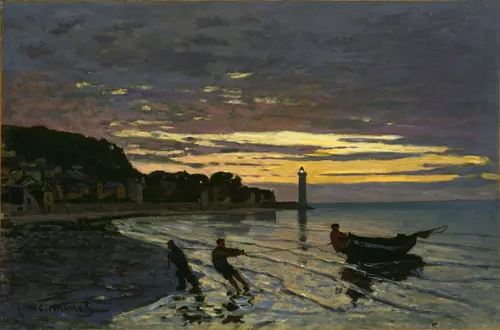
Claude Monet’s technique in "Hauling a Boat Ashore, Honfleur" demonstrates his mastery with oil on canvas. His loose, expressive brushwork brings the scene to life, making viewers feel the gentle breeze and shifting sunlight. As a leading figure in Impressionism, Monet’s craftsmanship is evident in every detail. For those inspired by this style, related paintings such as "Camille" and "The Railway Bridge at Argenteuil" offer additional glimpses into his evolving artistic journey.
Within "Hauling a Boat Ashore, Honfleur," Monet weaves stories of daily life and the enduring relationship between people and nature. This fine art painting for sale captures the essence of Impressionism—focusing on everyday moments and emotional resonance. The scene’s simplicity is deeply symbolic, echoing themes found in Monet’s "Rouen Cathedral Series" and "Road to the Saint-Simeon Farm." Each brushstroke tells a story, inviting viewers to find meaning beyond the visual.
For collectors seeking a unique hand-painted oil painting, "Hauling a Boat Ashore, Honfleur" by Claude Monet is a prized acquisition. Its value is enhanced by its association with the Impressionism movement and its connection to other iconic works like "Impression, Sunrise" and "The Cliff Walk at Pourville." Owning such a piece is not only an investment in art history but also an opportunity to enjoy Monet’s timeless vision every day.
When Art Meets History
"Hauling a Boat Ashore, Honfleur" by Claude Monet is a prime example of the Impressionism movement, capturing a fleeting moment in the bustling port of Honfleur. This hand-painted oil painting reflects the transformative era of late 19th-century France, when artists like Monet, Degas, and Renoir revolutionized art. Similar to related works such as "Le Pont de l'Europe" and "Racehorses at Longchamp," Monet’s masterpiece bridges the gap between history and the vibrant present of his time.
Techniques That Speak
Claude Monet’s mastery of oil on canvas shines in "Hauling a Boat Ashore, Honfleur." The brushwork is loose yet purposeful, characteristic of Impressionism’s focus on light and movement. Monet employs quick, visible strokes, capturing the changing atmosphere and shimmering water. This technique, also seen in "Les orangers" and "Dance At Bougival," allows viewers to experience the scene as if they were present, witnessing the daily life along the French coast firsthand.
Emotions on Display
In "Hauling a Boat Ashore, Honfleur," Monet conveys a sense of camaraderie and labor through his depiction of workers and boats. The painting’s luminous palette and dynamic composition evoke both the serenity and vigor of coastal life, hallmarks of Impressionism. As with "Ambroise Vollard" and other fine art painting for sale by Monet, the emotional resonance invites viewers to connect deeply with the ordinary moments that define human experience.
Coveted by Collectors
This remarkable painting stands as a testament to Claude Monet’s influence in the Impressionism movement and continues to captivate art enthusiasts worldwide. "Hauling a Boat Ashore, Honfleur" is highly sought after, much like Monet’s other masterpieces such as "Le Pont de l'Europe" and "Racehorses at Longchamp." Collectors prize this work for its historical significance, exquisite use of oil on canvas, and its enduring appeal as a centerpiece in any fine art collection.
Related Impressionism Hand-Painted Oil Paintings by Other Artists
Other Famous Impressionism Artists:
Frequently Asked Questions About Hauling a Boat Ashore, Honfleur
What is the historical context of "Hauling a Boat Ashore, Honfleur"?
This painting was created in 1868, during a period when Claude Monet was exploring the effects of light and color in his work. It reflects the artist's fascination with the coastal scenery of Honfleur, a picturesque port town in Normandy, France.
What artistic techniques did Monet employ in this painting?
Monet utilized loose brushwork and a vibrant color palette to convey the dynamic interplay of light and shadow on the water and the boat. His technique captures the momentary effects of light, a hallmark of Impressionism.
What are the key themes represented in "Hauling a Boat Ashore, Honfleur"?
The painting explores themes of labor and the relationship between humans and nature. It depicts the everyday activity of fishermen, highlighting the connection between the local community and their maritime environment.
How does this painting reflect Monet's Impressionist style?
Monet's Impressionist style is evident in the painting's emphasis on capturing a fleeting moment. The use of broken color and the absence of fine detail allow viewers to experience the scene as a vibrant, atmospheric impression rather than a precise representation.
What significance does the location of Honfleur hold in Monet's work?
Honfleur was a frequent subject for Monet and other Impressionists due to its scenic beauty and vibrant fishing community. The town's unique light and coastal landscapes provided an ideal setting for exploring the effects of light on water and boats.
In what ways does "Hauling a Boat Ashore, Honfleur" exemplify the use of color in Impressionism?
The painting showcases a rich palette of blues, greens, and warm earth tones, illustrating Monet's innovative use of color. He applied colors side by side rather than mixing them, allowing the viewer's eye to blend the hues from a distance.
What role does light play in this painting?
Light is a central element in "Hauling a Boat Ashore, Honfleur." Monet captures the shimmering reflections on the water's surface and the way sunlight interacts with the boat and figures, emphasizing the transient nature of the scene.
How does the composition of the painting contribute to its overall impact?
The composition features a dynamic arrangement of figures and boats, drawing the viewer's eye across the canvas. The diagonal lines created by the boat and the shoreline enhance the sense of movement and activity within the scene.
What influence did "Hauling a Boat Ashore, Honfleur" have on later artists?
This painting, along with Monet's other works, significantly influenced the development of modern art. Its emphasis on light, color, and everyday subjects paved the way for future movements, including Post-Impressionism and Fauvism.
What can we learn about Monet's artistic evolution from this work?
"Hauling a Boat Ashore, Honfleur" marks a critical point in Monet's artistic journey, showcasing his growing mastery of color and light. It reflects his transition towards a more abstract representation of reality, which would be further developed in his later works.






















_GFM_Painting_(1).webp)


 100% Hand-Painted: Finished in 3-6 Weeks

.png)















_(1).webp)